
Need Installation?
Book a licensed install
Book a licensed EV charger install

EV charging is the process of replenishing an electric vehicle’s battery through a dedicated power source, and for most drivers and businesses, it is the single most important factor in making EV ownership practical. Home charging is the preferred method for daily use because it lets you start every morning with a full battery, skipping fuel stops three to four times a week. Public and commercial electric vehicle charging stations fill the gaps for longer trips, fleet operations, and locations where home installation is not possible. Getting the right mix of home and commercial charging is what separates a frustrating EV experience from a genuinely convenient one.
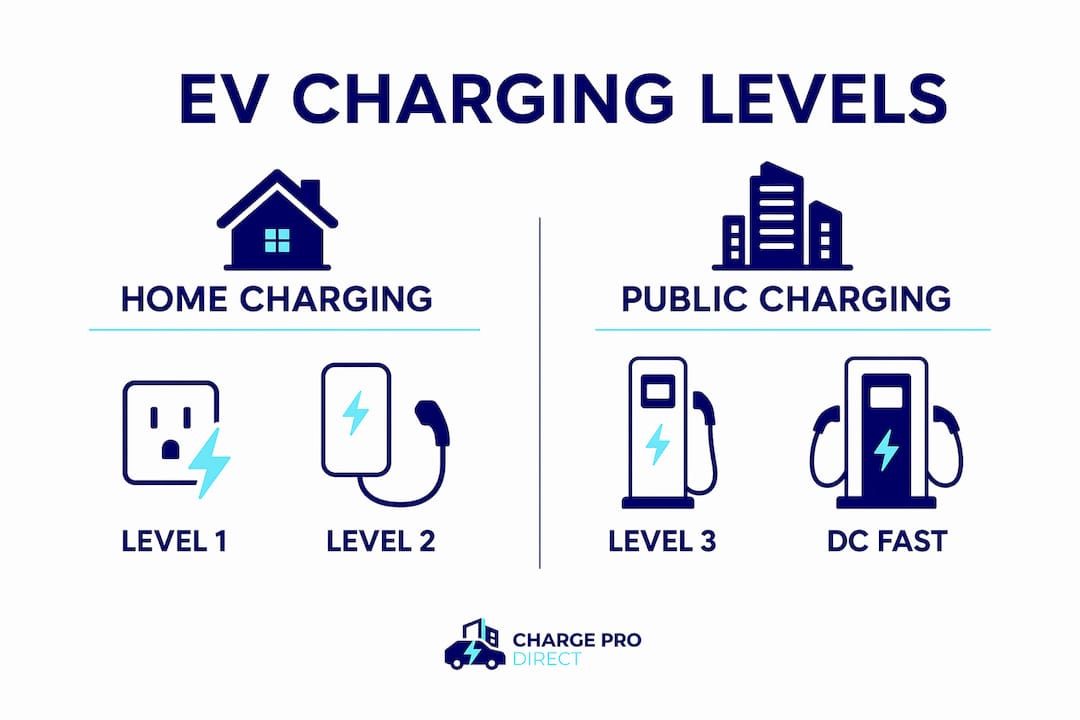
EV charging is divided into three levels, each defined by voltage, speed, and typical use case. Knowing the difference saves you from buying the wrong equipment or expecting the wrong results.
Level 1 charging uses a standard 120V household outlet, the same type that powers a lamp or phone charger. It adds roughly 3 to 5 miles of range per hour, which works for drivers with short daily commutes under 30 miles. No special installation is needed, but patience is required. A fully depleted 60 kWh battery can take 40 or more hours to fully charge at Level 1.
Level 2 charging runs on 240V, the same voltage as a clothes dryer or electric range. It adds 25 to 40 miles of range per hour, making it six to eight times faster than Level 1. This is the standard for home EV charger installation and most workplace or retail charging stations. A typical overnight charge of eight hours gives most EVs a full or near-full battery.
DC fast charging (also called Level 3) bypasses the vehicle’s onboard charger and delivers direct current straight to the battery. Speeds vary widely by station and vehicle, but commercial hubs can deliver up to 360 kW, enabling some vehicles to charge from 20% to 80% in under 30 minutes. DC fast charging is not designed for daily home use. It is the backbone of public charging for electric cars on highway corridors and high-traffic commercial sites.
| Charging level | Voltage | Typical amps | Speed (miles/hour) | Best use case |
|---|---|---|---|---|
| Level 1 | 120V | 12–16A | 3–5 | Short commutes, overnight top-ups |
| Level 2 | 240V | 16–80A | 25–40 | Home, workplace, retail |
| DC fast charge | 480V+ | 100–500A | 100–300+ | Highway stops, commercial hubs |
Pro Tip: Actual charging speed depends on your vehicle’s acceptance rate, not just the charger’s output. A charger rated at 48 amps delivers full speed only if your EV can accept that rate. Check your vehicle’s onboard charger spec before buying.
Installing a Level 2 home charger is treated electrically as adding a new dedicated 240V circuit to your home. That means a licensed electrician, a permit, and a final inspection are required in virtually every jurisdiction. The process is straightforward, but skipping any step creates safety and insurance risks.
Here is what the installation process typically involves:
Installation costs range from $300 to $2,000 depending on how far the panel is from the charging location, whether panel upgrades are needed, and local labor rates. Pre-wiring during new construction or a renovation cuts that cost significantly. If you are building a new home or remodeling a garage, adding an EV-ready 240V outlet during construction costs a fraction of retrofitting later.
Pro Tip: If you are building or remodeling, ask your contractor to rough in a 50 amp, 240V circuit in the garage even if you do not own an EV yet. The conduit and wiring cost very little during construction and saves hundreds of dollars later.
Safety certifications matter too. Look for chargers listed by UL (Underwriters Laboratories) or ETL, and choose weatherproof-rated units if the charger will be exposed to rain or temperature extremes. You can explore installation cost factors that apply to electrical upgrades alongside EV charger projects.
Commercial EV charging infrastructure operates at a different scale than home setups. A typical commercial hub uses multiple DC fast chargers arranged to serve 12 to 30 vehicles simultaneously, with individual stalls rated from 50 kW to 360 kW. Shell Recharge, ChargePoint, and Electrify America operate large-scale networks across the United States, each with hundreds of public locations.
The key factors that define a well-designed commercial charging hub are:
| Hub type | Typical power | Vehicles served | Ideal location |
|---|---|---|---|
| Retail destination | 25–75 kW | 4–12 | Shopping centers, hotels |
| Highway corridor | 150–350 kW | 8–20 | Rest stops, travel plazas |
| Fleet depot | 19–80 kW | 10–50 | Warehouses, transit yards |
| Urban fast hub | 50–150 kW | 6–16 | Parking garages, city centers |
Home charging accounts for about 60% of the global charger stock, but public and commercial charging is what makes EV adoption viable for apartment dwellers, renters, and fleet operators without dedicated facilities. The IEA’s 2026 data confirms that public charging grew rapidly but still supplements rather than replaces private charging for most users.
Choosing the right charging level depends on your daily mileage, parking situation, and how much flexibility you need. Most individual EV owners benefit most from a Level 2 home charger as their primary solution, with public fast charging as a backup for road trips or emergencies.
| Factor | Home Level 2 | Commercial/Public DC fast |
|---|---|---|
| Cost per session | Low (home electricity rate) | Moderate to high (network pricing) |
| Charging speed | 25–40 miles/hour | 100–300+ miles/hour |
| Convenience | Highest (charge while you sleep) | Varies by location and availability |
| Battery longevity | Better (slower charge cycles) | More wear with frequent fast charging |
| Best for | Daily drivers, homeowners | Road trips, fleet ops, apartment renters |
Businesses with employee parking or customer-facing facilities benefit from adding Level 2 workplace chargers as an amenity, with DC fast charging reserved for high-traffic or fleet-heavy operations. The convenience of overnight charging means most home-based drivers never need to visit a public station for routine use. That said, a combined strategy, using home charging for daily needs and public charging for longer trips, gives you the most flexibility at the lowest overall cost.
Good planning prevents costly mistakes and positions your setup for future growth. Whether you are a homeowner adding a single charger or a business deploying a multi-stall commercial station, these practices apply:
Pro Tip: Use the EV charging savings calculator at Chargeprodirect to see exactly how much you save annually by charging at home versus filling up at a gas station. The numbers are often more compelling than people expect.
A Level 2 home charger combined with selective use of public DC fast charging delivers the best balance of cost, convenience, and battery health for most EV owners and businesses.
| Point | Details |
|---|---|
| Level 2 is the home standard | It adds 25 to 40 miles per hour and covers most daily driving needs overnight. |
| Installation requires a licensed electrician | A dedicated 240V circuit, permit, and inspection are required for safe Level 2 setup. |
| Commercial hubs need careful planning | Grid capacity, stall count, and dwell time alignment determine hub efficiency and profitability. |
| Off-peak charging cuts costs significantly | Time-of-use rates can reduce electricity costs by 30 to 50 percent with scheduled overnight charging. |
| Home charging dominates globally | Home charging represents about 60% of charger stock, confirming it as the primary daily solution. |
Many homeowners and business owners buy an EV charger before calling an electrician. That is when the surprises show up: a panel that needs upgrading, a garage that is too far from the breaker box, or a permit process that adds weeks to the timeline. The charger itself is rarely the hard part. The electrical infrastructure behind it is where the real decisions live.
Many people treat EV charging like buying a phone charger. You plug it in and it works. But a Level 2 charger is a 240V appliance drawing continuous current for six to ten hours. That demands the same respect you would give a new HVAC system or a kitchen range. The upfront planning, getting the right amperage, sizing the circuit correctly, and thinking about where you might be in five years with two EVs instead of one, pays off every single time.
A common business mistake is buying chargers before assessing utility service. A four-stall DC fast charging setup can easily require 200 to 400 kW of dedicated service. If your building’s transformer cannot support that, you are looking at a utility upgrade that takes months and costs tens of thousands of dollars. Start with the grid, then choose the chargers.
The good news is that none of this is complicated once you know what questions to ask. And the long-term savings, on fuel, on maintenance, and on time, make the upfront work more than worth it.
Ready to move from research to action? Chargeprodirect makes it straightforward to find the right Level 2 charger for your home or business without guesswork.

Our charger finders narrow your options based on your actual power situation, daily mileage, and installation conditions. Whether you need a single home unit or a multi-stall commercial charging solution, the platform matches you with certified, efficient hardware and helps you avoid the pre-installation errors that cost time and money. Use the EV Charger Finder to identify your ideal Level 2 home charger, or the Commercial EV Charger Finder if you are outfitting a business or fleet. Residential EV chargers ship free, and flexible payment plans are available at checkout.
Level 1 uses a standard 120V outlet and adds 3 to 5 miles of range per hour. Level 2 uses a 240V circuit and adds 25 to 40 miles per hour, making it the practical standard for home and workplace charging.
Residential Level 2 charger installation typically costs between $300 and $2,000, depending on panel capacity, distance from the breaker box, and whether electrical upgrades are needed.
DC fast chargers can add 100 to 300 or more miles of range per hour, with some commercial stations rated up to 360 kW. Many vehicles can charge from 20% to 80% in under 30 minutes at a high-power station.
Home Level 2 charging is better for long-term battery health because slower charge rates generate less heat and stress on battery cells. Frequent DC fast charging accelerates battery wear over time.
Yes. Installing a Level 2 charger requires a dedicated 240V circuit, a licensed electrician, a local permit, and a final inspection in virtually all U.S. jurisdictions.