
Need Installation?
Book a licensed install
Book a licensed EV charger install

The rule is simple: multiply your EVSE’s rated amps by 1.25, then round up to the next standard breaker size listed in NEC 240.6(A). Size your conductors to match that breaker. That single formula covers nearly every residential Level 2 install.
Here are the most common pairings you will encounter:
Three things to confirm before you call it done: size the conductor to the breaker ampacity (not the EVSE amps), use a dedicated branch circuit, and follow both the EVSE nameplate and your local Authority Having Jurisdiction (AHJ) requirements. The U.S. Department of Energy recommends treating an EV charger as a major home electrical addition and following manufacturer instructions, utility guidance, and local code throughout.
Selecting the right EV charger breaker size comes down to one formula: EVSE amps × 1.25 = minimum circuit ampacity, then round up to the next standard breaker and size conductors to match.
| Point | Details |
|---|---|
| Core sizing formula | Multiply EVSE rated amps by 1.25 and round up to the next standard breaker size per NEC 240.6(A). |
| 48A charger standard | A 48A EVSE requires a 60A two-pole breaker and #6 AWG copper conductors as the typical minimum. |
| Conductor temperature column | Use the 60°C column for NM-B cable and when terminals are rated 60°C; the 75°C column only when both ends allow it. |
| Long-run voltage drop | Upsize conductors one or two AWG sizes on runs over 50 feet to keep voltage drop under 3%. |
| Chargeprodirect guidance | The Chargeprodirect EV Charger Finder helps match EVIQO Level 2 charger models to common 40A and 48A home circuits. |
The quick-reference table below maps the most common EVSE output ratings to their minimum circuit ampacity, recommended standard breaker, and typical minimum copper conductor size using the 75°C ampacity column.
Per the NEC 625 load calculator, the 125% rule is the single most important concept in EVSE sizing, and these pairings reflect standard field practice.
A few caveats worth knowing before you order wire:
Pro Tip: Always read the EVSE nameplate and the terminal temperature rating in the installation manual before choosing conductor size. A charger that lists 60°C terminals forces you to use the 60°C ampacity column even if you are pulling THHN in conduit.
This method works for any Level 1 or Level 2 charger. Follow these steps in order.
Read the EVSE nameplate. Record the rated output current in amps, the voltage (120V or 240V), whether the unit is cord-and-plug or hardwired, and the UL or ETL listing file number. A UL-listed appliance and a UL-listed piece of equipment can have different allowable breaker sizing rules, so the listing type matters.
Calculate minimum circuit ampacity. Multiply the nameplate amps by 1.25. This is the NEC continuous-load rule: a load that runs for three hours or more must not exceed 80% of the circuit’s rated ampacity, which is the same as saying the circuit must be sized to at least 125% of the load.
Select the standard breaker size. Using NEC 240.6(A), round up to the next standard size above your calculated minimum. Standard sizes include 15, 20, 25, 30, 35, 40, 45, 50, 60, 70, 80, 90, 100A, and so on.
Size conductors to the chosen breaker. Conductors must be rated for the breaker ampacity, not just the EVSE load. Use the correct temperature column for your terminal ratings.
Confirm grounding and protective device requirements per NEC Article 625 and your AHJ’s local amendments.
Worked example for a 48A hardwired charger:
The Intry EV charger installation calculator confirms this pairing and also flags voltage drop on longer runs, which you will want to check separately.
Nameplate data to record before calling your electrician:
Conductor selection is where most DIY sizing errors happen. The breaker size sets the floor, but the conductor type and installation method determine which ampacity table you actually use.
| Breaker Size | Min. Copper AWG (75°C) | Min. Copper AWG (60°C) | Typical Use Case |
|---|---|---|---|
| 30A | #10 AWG | #10 AWG | 24A EVSE, short runs |
| 40A | #8 AWG | #8 AWG | 32A EVSE |
| 50A | #8 AWG | #6 AWG | 40A EVSE, NM-B in walls |
| 60A | #6 AWG | #4 AWG | 48A EVSE, conduit runs |
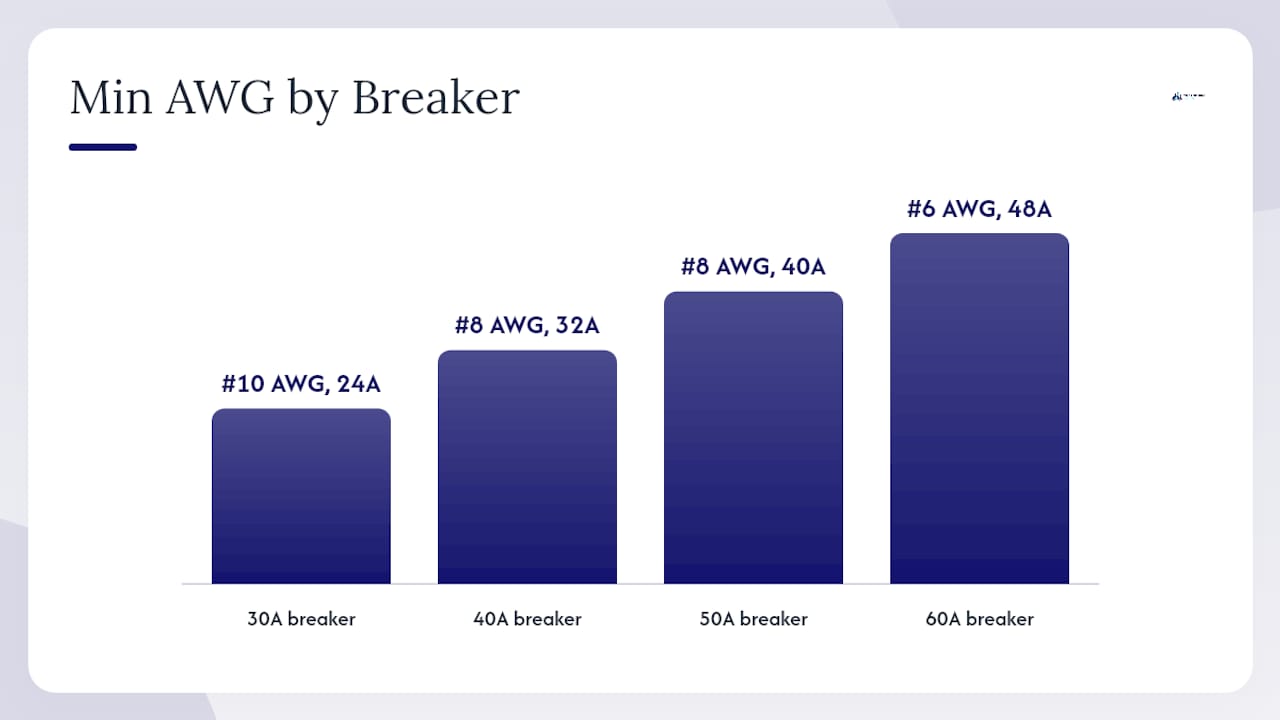
THHN/THWN in conduit is the preferred conductor for garage and outdoor runs. It uses the 75°C column when terminals allow, giving you more ampacity per gauge than NM-B. THHN also handles conduit fill and moisture better than cable assemblies.
NM-B (Romex) is limited to the 60°C column per NEC 334.80, regardless of the conductor’s insulation rating. That means #8 NM-B tops out at 40A, not 50A. If your 40A EVSE calculation lands on a 50A breaker, NM-B in the wall requires #6 AWG to stay code-compliant.
Derating scenarios to watch for:
Pro Tip: #6 AWG copper is the most versatile residential EV charger conductor. It satisfies both 50A scenarios (at 60°C terminals) and 60A scenarios (at 75°C terminals), which is why electricians often pull #6 regardless of which EVSE is going in. Confirm terminal ratings first, but #6 rarely needs to be revisited.
NEC Article 625 governs EVSE installations specifically and adds requirements on top of the standard branch-circuit rules.
Key protective device requirements to confirm with your AHJ:
Both options are code-compliant when installed correctly. The choice affects your breaker size, flexibility, and long-term options.
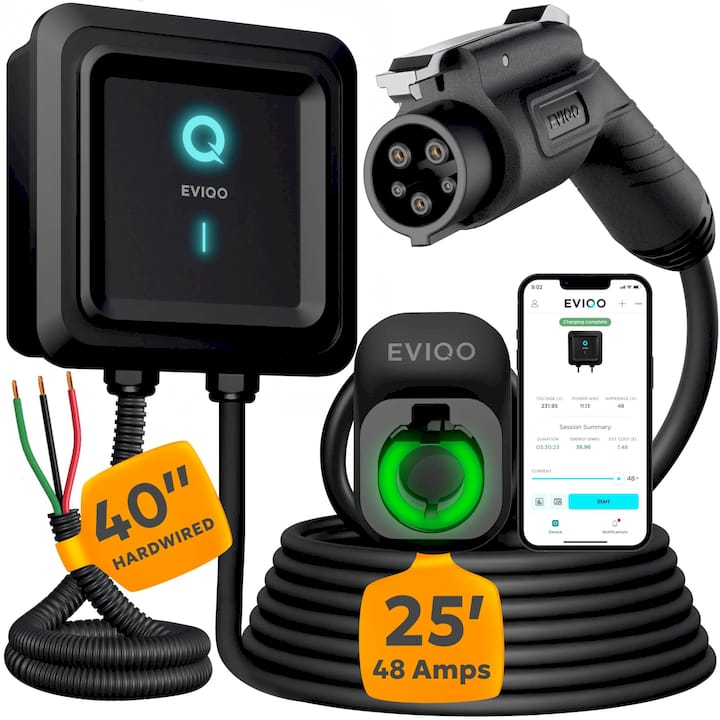
Hardwired units connect directly to the circuit with no receptacle in between. They tend to be more reliable in wet or dusty environments, and they eliminate the wear point of a plug. The tradeoff is that moving or replacing the charger requires an electrician. The EVIQO 48A hardwired model is a common example of this configuration, requiring a 60A two-pole breaker and #6 AWG copper.
Plug-in units with a NEMA 14-50 receptacle give you flexibility. You can unplug and take the charger with you, and replacing the unit does not require rewiring. The NEMA 14-50 receptacle itself is rated for 50A, but the continuous-load rule limits the charger to drawing no more than 40A continuously on that circuit. That means a 40A EVSE is the practical maximum for a NEMA 14-50 setup, even though the receptacle is rated 50A. The NEMA 14-50 outlet guide covers this in more detail.
NEMA 6-50 is a 240V, 50A receptacle without the neutral conductor. Some chargers support it, and it works the same way for sizing purposes.
Questions to ask your installer or AHJ before deciding:
Adding a Level 2 charger is the largest continuous load most homes have added in decades. A 48A charger on a 60A circuit draws about 11.5 kW continuously, comparable to running three electric dryers at once.
To estimate available headroom, start with a simple field check: count the open breaker spaces in your panel and add up the amperage of your largest existing loads (HVAC, electric range, water heater, dryer). If your panel is a 200A service and your existing loads total 150A or more at peak, you may not have room for a 60A EV circuit without a load calculation.
Signs a service upgrade may be needed:
You do not always need a full service upgrade. Alternatives include:
Pro Tip: Ask your electrician for a load calculation per NEC Article 220 before committing to a charger amperage. That calculation often reveals you have more headroom than a quick panel count suggests, or it catches a problem before you have already purchased a 60A breaker.
The Alternative Fuels Data Center recommends consulting your utility as well, since some utilities offer rebates or special EV rates that can affect how you size and schedule charging.
Level 2 EV charging is the largest continuous residential load many homes will add, and sizing errors are among the most frequent causes of inspection failures.
Mistakes to avoid:
A homeowner installs an EVIQO 40A plug-in charger in a garage 20 feet from the panel.
Same charger, but the panel is 80 feet away in a detached garage.
Per voltage drop guidance for EV charger runs, upsizing one or two conductor sizes on runs over 50 feet is standard practice.
Sizing checklist (use this like a manual calculator):
Pro Tip: If your panel cannot support a 60A circuit, set the charger’s adjustable current limit to 32A or 40A and size the circuit accordingly. Record that setting in writing and show it to the inspector. Many modern chargers, including the EVIQO models, let you dial down the output without any hardware changes.
The 80% rule and the 125% rule are two ways of saying the same thing. Under NEC Article 625, EV charging is classified as a continuous load because it typically runs for three hours or more. A continuous load must not exceed 80% of the circuit’s rated ampacity, which means the circuit must be rated at least 125% of the load.
This is why a 48A charger needs a 60A breaker, not a 50A breaker. 48A is 96% of a 50A breaker’s rating, which violates the 80% continuous-load limit. 48A is exactly 80% of 60A, which is the minimum compliant breaker.
The practical effect: you cannot simply match the breaker to the charger’s rated output. A detailed NEC 220.57 guide explains that for load calculation purposes, you use either 7,200 VA or the EVSE nameplate rating, whichever is larger, and apply the 125% multiplier to that figure. For most home chargers rated above 30A, the nameplate rating governs.
A UL listing is not just a safety badge. It is a legal requirement under NEC 625.5, and it directly constrains how you wire the circuit.
When a charger is UL-listed, the listing covers the unit as tested with specific installation conditions. The manufacturer’s installation manual is part of that listing. If the manual specifies a maximum breaker size of 60A, installing a 70A breaker to gain headroom is a code violation, even if the math suggests it would work. Conversely, if the manual requires a minimum 50A breaker, you cannot use a 40A breaker even if your calculation technically allows it.
UL-listed appliances and UL-listed equipment follow slightly different rules under the NEC. Most residential EV chargers are listed as equipment under UL 2594, which governs EVSE specifically. That listing standard sets the test conditions and the installation parameters the manufacturer must publish. Your electrician and inspector will both check that the installation matches those parameters.
Practical steps to stay compliant:
The NEC 220.57 sizing guide notes that bringing the charger nameplate and the load calculation output to the inspection reduces back-and-forth with the inspector significantly.
At Chargeprodirect, the most common question homeowners ask is not “which charger is fastest” but “will my panel support it?” That is the right question to ask first. Our approach is to help you match the charger output to what your panel can actually support, then select the product that fits that circuit rather than the other way around.
For most homeowners, a 40A plug-in or a 48A hardwired setup covers the majority of daily driving needs. Our EV Charger Finder walks you through your power situation before recommending a specific model. If you are not sure whether your panel has room for a 60A circuit, that tool is the right starting point.
Knowing your breaker size is the hard part. Finding the right charger to match it should be straightforward.
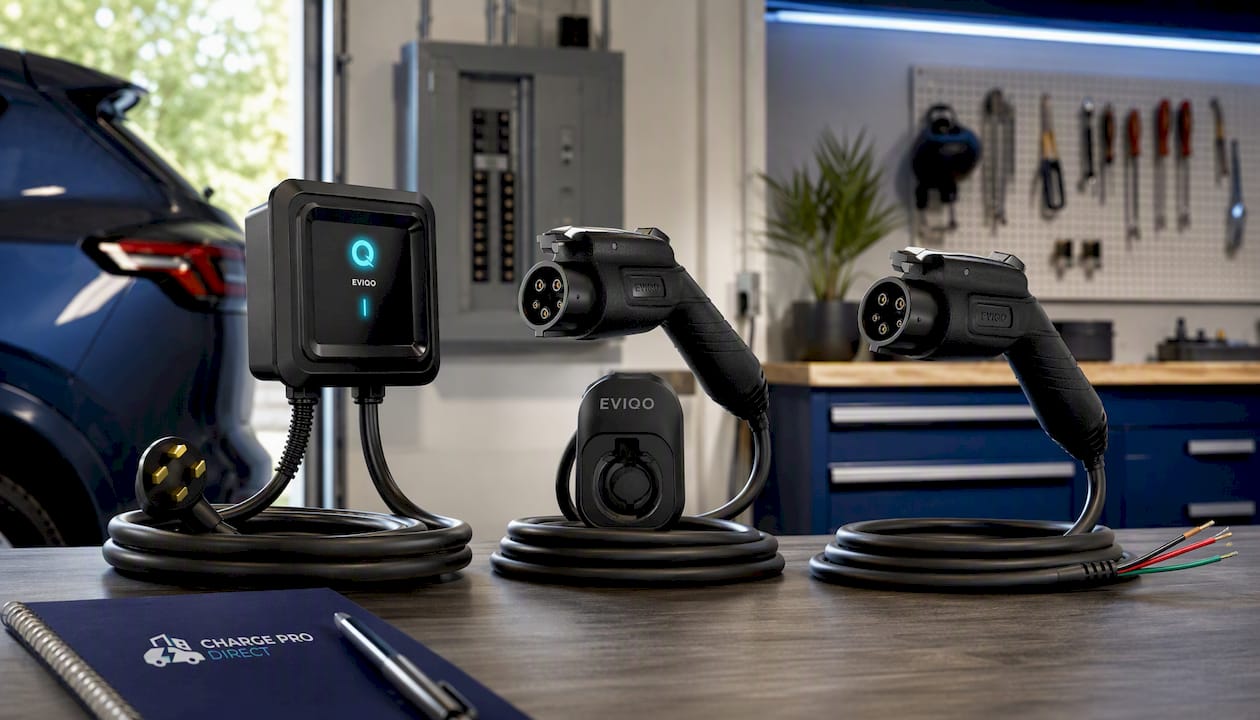
The EVIQO 48A hardwired charger is built for the 60A circuit that most electricians recommend for future-proofing a home install. If you prefer a plug-in setup on a NEMA 14-50 receptacle, the EVIQO 40A plug-in model fits a 50A circuit and delivers up to 9.6 kW. Both are J1772-compatible for non-Tesla EVs. Residential EV chargers ship free. Before finalizing any purchase, verify the nameplate requirements against your panel capacity, and confirm the installation with a licensed electrician and your local AHJ.
Use the EV Charger Finder to get a personalized recommendation based on your home’s actual power situation.
Use these resources to back up your permit conversations and verify local requirements:
Tesla also offers a 40A configuration that works on a 50A breaker.
Yes, a 40A breaker supports an EVSE rated at up to 32A continuously (32 × 1.25 = 40A).
A 60A breaker requires #6 AWG copper minimum using the 75°C ampacity column, or #4 AWG copper if terminals are rated only for 60°C or if the run exceeds roughly 50 feet and voltage drop is a concern.
A 60A circuit supports a 48A EVSE, which delivers about 11.5 kW and adds roughly 30–40 miles of range per hour of charging. That covers the daily driving needs of most households with a single EV.