
Need Installation?
Book a licensed install
Book a licensed EV charger install

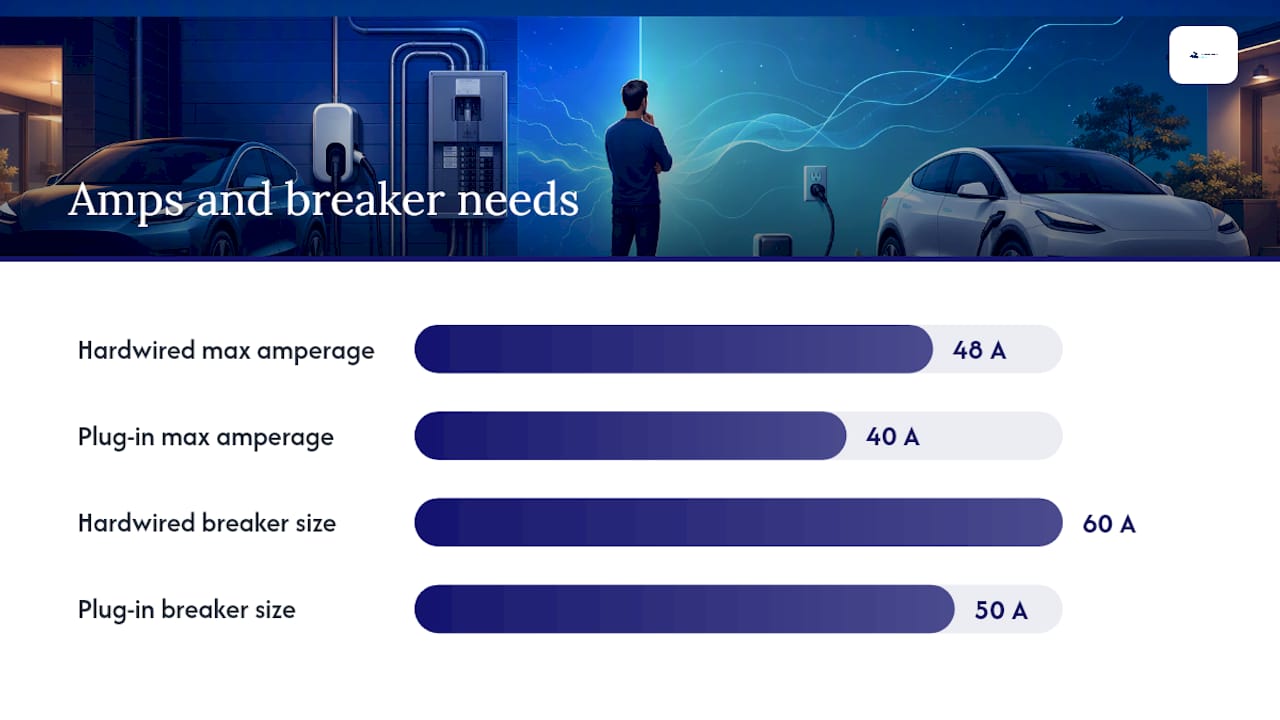
For most homeowners who plan to stay in their house and want the fastest, most reliable Level 2 charging, a hardwired connection is the better choice. It supports up to 48A (11.5 kW) on a 60A breaker, delivers a more weatherproof installation, and removes the outlet as a potential failure point.
For most homeowners, hardwired Level 2 charging delivers more speed, better weatherproofing, and greater long-term reliability than a plug-in setup on a NEMA 14-50 outlet.
| Point | Details |
|---|---|
| Hardwired tops out at 48A | A hardwired unit on a 60A breaker adds roughly 44 miles of range per hour versus 30–37 miles at 40A plug-in. |
| Plug-in wins for portability | Renters or frequent movers benefit from a NEMA 14-50 plug-in unit they can take to the next address. |
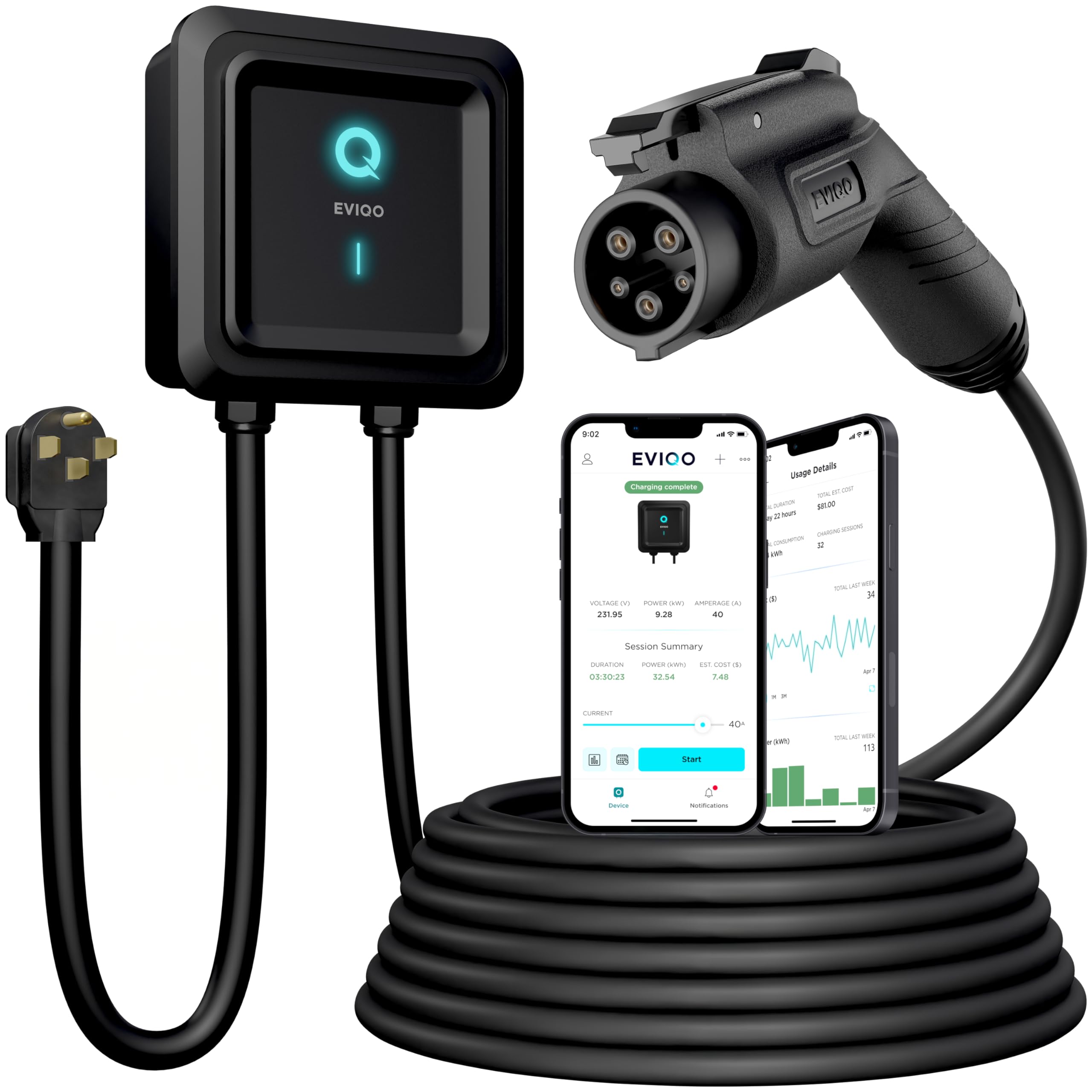
| Check your vehicle’s onboard charger | If your EV accepts 40A or less, a 48A hardwired station will not increase your charge rate. |
| Permits are required for both | NEC Article 625 and local AHJ rules apply to hardwired and plug-in installs alike; always pull a permit. |
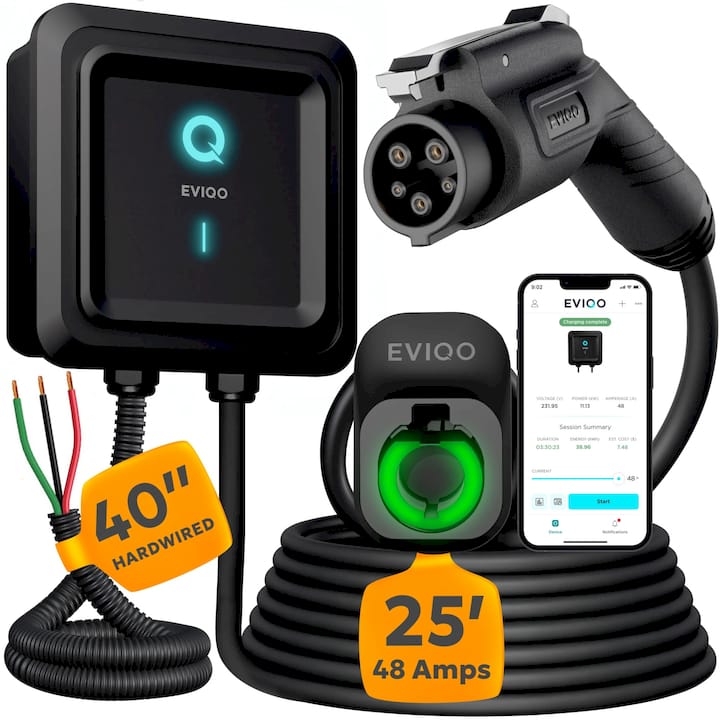
| Chargeprodirect matches you to the right unit | The EVIQO 48A hardwired and 40A plug-in models cover both installation paths, with a free EV Charger Finder to guide your choice. |
The table below covers the dimensions that matter most when you’re talking to an electrician or comparing charger models.
| Dimension | Hardwired | Plug-In (NEMA 14-50) |
|---|---|---|
| Typical amperage | Up to 48A (11.5 kW) | Up to 40A (9.6 kW) |
| Portability | Fixed; stays with the home | Unplug and take it with you |
| Installation complexity | Licensed electrician required; dedicated circuit | Easier if outlet exists; still needs a dedicated circuit |
| Code and permits | NEC Article 625; permit usually required | Permit often required; outlet must be on a dedicated circuit |
| Durability and weatherproofing | Sealed connection; fewer exposed failure points | Receptacle and plug exposed to moisture and wear |
| Upgradeability | Swap the unit; breaker/wire may need upsizing | Same circuit upgrade needed; unit is portable |
| Warranty considerations | Check for outdoor/weather rating | Receptacle quality affects coverage; inspect regularly |
Two quick decision signals worth keeping in mind:
One detail that catches homeowners off guard: the NEC continuous-load rule requires a circuit rated at 125% of the charger’s continuous draw. A 40A charger needs a 50A breaker; a 48A charger needs at least a 60A breaker. That breaker size difference has real cost implications when your panel is already near capacity.
The electrical math here is straightforward. A plug-in charger on a NEMA 14-50 outlet is limited to 40A continuous by both the outlet rating and NEC rules. A hardwired unit on a 60A breaker can run at 48A continuously, which translates to a meaningful speed difference for many vehicles.
In practical terms, 48A adds roughly 44 miles of range per hour while 40A typically adds 30–37 miles per hour, depending on the vehicle. For a driver covering 40–50 miles a day, the plug-in unit fully replenishes overnight either way. For someone driving 80–100 miles daily, the 8A difference can matter.
Here’s the part most articles skip: your vehicle’s onboard AC charger is the real ceiling. If your EV accepts a maximum of 32A or 40A from its onboard charger, installing a hardwired 48A station will not increase your charge rate at all. Check your vehicle’s onboard charger spec before paying extra for higher amperage.
Pro Tip: When buying a Level 2 charger, look for a model rated at 48A hardwired even if your current car tops out at 40A. The wiring and breaker you install today can support a faster vehicle later without rewiring the circuit.
The short answer is yes, particularly for outdoor and long-term installations. Hardwiring removes the external receptacle entirely, which eliminates one of the most common failure points on a plug-in setup: the connection between the plug and the outlet.
Plug-in installs put a NEMA 14-50 receptacle under continuous high-current load, sometimes for hours every night. Low-quality receptacles are a documented cause of overheated connectors on plug-in circuits. Professional installer guidance recommends industrial-grade NEMA 14-50 receptacles and periodic torque checks on the outlet terminals to reduce this risk.
GFCI protection adds another wrinkle. Many EVSE units include internal ground fault protection. When a plug-in charger is installed on a GFCI-protected outlet or circuit, you can end up with two GFCI devices in series. That stacking can cause nuisance trips where the charger cuts out for no apparent fault. Hardwiring avoids this by removing the external GFCI receptacle from the equation.
Outdoors, the gap widens further. Manufacturers commonly recommend hardwiring for outdoor installs because a sealed, direct connection resists moisture far better than an exposed plug-and-receptacle pair. Look for an IP or NEMA enclosure rating on any charger you plan to mount outside, and confirm the installation method matches the manufacturer’s outdoor guidance to preserve your warranty.
NEC Article 625 governs EV charging equipment in the United States. The two rules that affect your hardwired vs plug-in decision most directly are the continuous-load sizing rule and the outlet-rating ceiling.
The continuous-load rule: any load that runs for three hours or more is considered continuous, and the circuit must be rated at 125% of that load. A 40A charger therefore requires a 50A breaker and 6 AWG wire minimum, and a 48A charger requires a 60A breaker and typically 4 AWG wire. Above 40A continuous, NEC practice effectively requires hardwiring because no standard residential receptacle is rated for that load.
Pro Tip: Before your electrician visits, pull your panel’s load calculation or ask them to do it on site. Knowing your available capacity upfront prevents the most common inspection delay: discovering the panel is full after the conduit is already run.
What to expect from the permit process:
For a deeper look at panel capacity and load calculations, that step alone can determine whether your project costs $500 or $3,000.
The simplest plug-in scenario: a NEMA 14-50 outlet already exists on a dedicated 50A circuit in your garage. You mount the charger, plug it in, and you’re done in under an hour. That scenario is genuinely straightforward, and it’s why plug-in units are popular for early adopters.
Every other scenario involves an electrician and a permit. Here’s the typical workflow:
Primary cost drivers to watch for:
When a new dedicated circuit, a GFCI device, and a quality outlet are all required, the total cost of a plug-in install can approach a hardwired install. Get an itemized quote that separates labor, materials, permit fees, and any panel work. A full breakdown of EV charger installation costs can help you compare bids accurately.
This is where a common assumption trips people up. Many EV owners believe a plug-in charger is easier to upgrade because you can just swap the unit. The circuit is the gatekeeper. Changing to a higher-amperage charger typically requires a new breaker and possibly new wire whether the unit is plug-in or hardwired.
The good news: many EVSE units use the same physical hardware regardless of termination method. If your unit supports both supply terminations and local code permits the conversion, an electrician can sometimes switch a plug-in unit to hardwired or vice versa without replacing the charger itself.
Moving a hardwired charger to a new home means disconnecting it, capping the wires, and reinstalling at the new location, which requires an electrician at both ends. A plug-in unit comes with you in the moving truck and plugs into any compatible NEMA 14-50 outlet at the new address.
Key checks before upgrading to 48A:
Work through this checklist before you call an electrician or order a charger.
Confirm these details with your electrician before signing a quote:
Pro Tip: Ask your electrician to quote both a plug-in (with a new NEMA 14-50 outlet) and a hardwired install on the same visit. When a new dedicated circuit is required either way, the price difference is often smaller than you’d expect, and hardwired gives you more for the same money.
If you’re pairing your EV charger with rooftop solar or a home battery, a solar and utility cost comparison can help you model the full energy picture before committing to a circuit size.
Maintenance on a Level 2 charger is straightforward, but skipping it can void your warranty or create a safety issue.
Call a licensed electrician if you notice the outlet or plug feeling warm after a charging session, if the breaker trips repeatedly, or if the charger reports a fault code related to ground fault or overcurrent. Contact manufacturer support for firmware issues, app connectivity problems, or questions about the unit’s internal electronics. Avoiding common installation mistakes from the start is the best way to keep maintenance simple.
The hardwired vs plug-in debate gets more complicated than it needs to be online. Most of the time, the right answer comes down to two questions: do you own your home, and does your vehicle’s onboard charger actually benefit from more than 40A? If both answers are yes, hardwired is worth the extra installation effort. If either answer is no, a plug-in unit on a quality NEMA 14-50 outlet is a perfectly solid choice for many EV owners.
What we would push back on is the idea that plug-in installs are always the “easy” option. When you factor in a new dedicated circuit, a GFCI breaker, and a premium outlet, the cost gap narrows considerably. And for outdoor installs, the sealed connection of a hardwired unit genuinely outperforms an exposed receptacle over years of weather exposure. Lean on a licensed electrician and pull the permit. The inspection exists to protect you, and the paperwork matters when you sell the house.
You’ve done the research. Now the practical next step is matching your decision to the right unit.

For homeowners who want maximum charging speed and a permanent outdoor-ready install, the EVIQO Level 2 EV Charger, 48A Hardwired delivers 11.5 kW on a 60A circuit with a sealed, weatherproof connection built for long-term reliability. For renters or homeowners with an existing NEMA 14-50 outlet, the EVIQO 40A NEMA 14-50 Plug-In gives you 9.6 kW of charging with the flexibility to take the unit with you. Chargeprodirect also carries the EVIQO 48A NEMA 14-50 Plug-In. On a NEMA 14-50 outlet, set it to 40A. The full 48A requires hardwiring on a 60A circuit. Not sure which fits your setup? Use our EV Charger Finder to get a recommendation based on your vehicle and home electrical capacity. Residential EV chargers ship free.
Hardwired is better for most homeowners who own their home and want maximum speed and long-term reliability. Plug-in on a NEMA 14-50 outlet is the right call for renters or anyone who needs to move the charger.
If your vehicle’s onboard charger accepts more than 40A and you plan to stay in your home, choose hardwired for the 48A ceiling and sealed connection. If you already have a NEMA 14-50 outlet or you rent, a plug-in unit works well and costs less to install.
A hardwired charger is fixed to the wall, so you cannot take it with you if you move. It also requires a licensed electrician for both installation and removal, and the permit process adds time and cost upfront.
A hardwired charger connects directly to your home’s electrical system through a dedicated circuit, with no plug or outlet in between. The wires run from your breaker panel straight to the charger’s junction box, which removes the receptacle as a potential failure point.