
Expert Support
Mon–Fri, 9AM–6PM EST
Available: Mon–Fri, 9AM–6PM EST
Mon–Fri, 9AM–6PM EST
Available: Mon–Fri, 9AM–6PM EST

Fleet vehicle range anxiety is the operational fear that an electric vehicle will run out of charge before completing its assigned route, creating stranded vehicle incidents that cost between $300 and $500 per event in direct costs alone. This concern is not irrational. Real-world EV range runs 20 to 40% below EPA-rated figures under commercial operating conditions, meaning a van rated at 250 miles may reliably deliver only 150 to 200 miles on a loaded delivery route in winter. Understanding fleet vehicle range anxiety explained in full requires looking at both the technical causes and the operational planning gaps that make it worse. The good news is that AI-powered routing, telematics, and smart charging strategies have made this a solvable problem for most fleets.
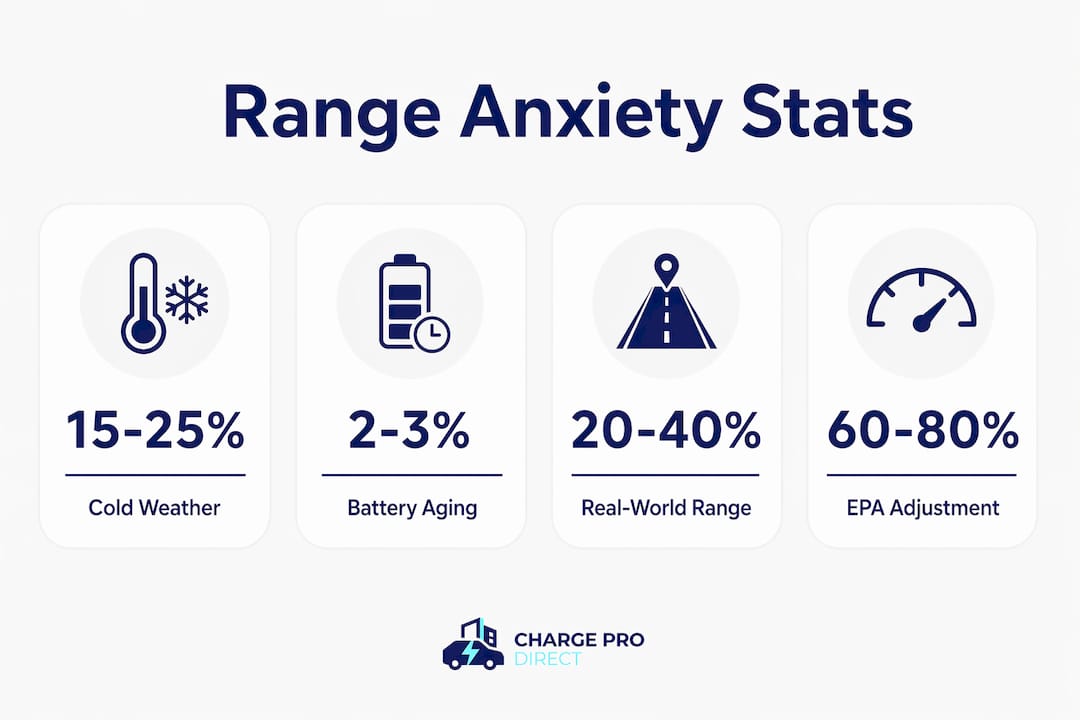
The gap between EPA-rated range and actual fleet performance is the starting point for understanding driving range anxiety. EPA testing uses controlled conditions with no payload, moderate temperatures, and steady speeds. Your fleet operates nothing like that.
Cold weather is the single biggest variable. Winter range drops 15 to 25% at 32°F and can fall 35 to 40% at 0°F. That means a vehicle rated at 250 miles could deliver fewer than 160 miles on a cold January morning. Cabin heating is the primary culprit. Cabin heating is the top battery drain in cold climates, pulling significant energy away from propulsion.
Payload weight compounds the problem. A delivery van loaded to capacity uses measurably more energy per mile than the same vehicle empty. Elevation changes add another layer. A route with 1,500 feet of cumulative elevation gain will drain the battery faster than a flat suburban loop of the same distance. Driving speed matters too. Highway speeds above 65 mph increase aerodynamic drag and reduce range compared to urban stop-and-go driving where regenerative braking recovers energy.
Pro Tip: Pre-condition your vehicles while they are still plugged in at the depot. This transfers the energy cost of heating or cooling the cabin to the grid rather than the battery, preserving 15 to 20% of usable route range.
Battery degradation is a real but often overstated concern. EV batteries degrade at roughly 2 to 3% per year, and modern software management systems offset much of that loss. Vehicles retain approximately 97% of original range after three years of use. For fleet planning purposes, build a 5% range reduction into your baseline for vehicles older than two years, but do not treat aging batteries as a crisis.
| Factor | Estimated Range Impact |
|---|---|
| Cold weather (32°F) | 15 to 25% reduction |
| Cold weather (0°F) | 35 to 40% reduction |
| Full payload vs. empty | 8 to 15% reduction |
| Highway speeds (70+ mph) | 10 to 20% reduction |
| Battery aging (per year) | 2 to 3% reduction |
| Pre-conditioning (benefit) | +15 to 20% preserved |
42% of fleet managers cite driving range as their top concern when selecting electric vans, particularly in smaller fleets with fewer backup vehicles. That statistic reflects a real operational barrier, not just a perception problem. When managers are uncertain about range, they make conservative dispatch decisions that underutilize the fleet.
The operational impacts of electric vehicle range concerns show up in several ways:
Range anxiety is primarily a planning problem, not a technology limitation. Fleets that treat it as a data visibility and process challenge solve it. Fleets that treat it as a vehicle deficiency stall their electrification programs. The distinction matters because the solution set is completely different.
Abandoning the diesel refueling mindset is the first operational shift required. Diesel vehicles refuel in five minutes at any station. EVs charge over hours at planned locations. Dispatchers who plan around that reality stop experiencing range anxiety as a crisis and start treating it as a scheduling variable.
Managing range anxiety at scale requires integrating three technology layers: AI-powered routing, telematics, and smart charging infrastructure. Each layer addresses a different part of the problem.
AI route planning matches each vehicle to routes using documented safety margins that account for payload, terrain, temperature, and current state of charge. This replaces the dispatcher’s manual judgment with data-driven dispatch that eliminates stranded vehicle risk. The system continuously monitors telemetry and sends dynamic alerts if conditions change mid-route.
The practical result is that dispatchers stop guessing. A vehicle with 180 miles of estimated real-world range gets assigned to a 140-mile route with a 20% safety buffer built in. If a last-minute load addition changes the energy math, the system flags it before the driver leaves the depot.
Pro Tip: Categorize your routes into three tiers based on energy demand: short (under 60% of vehicle range), medium (60 to 80%), and long (80 to 95% with a planned charge stop). Automate dispatch to match vehicles to tiers by current state of charge. This single process change eliminates most stranded vehicle risk.
Telematics platforms integrate battery state of charge, payload weight, route elevation, weather data, and driving behavior into a single dynamic range estimate. This closes the information gap that creates anxiety in the first place. Dispatchers see actual usable range, not the EPA number on a spec sheet.
The difference is significant. A telematics system might show that Vehicle 14 has 73% state of charge but is carrying a heavy load on a hilly route in 28°F weather, giving it an effective range of 110 miles rather than the 160 miles its charge level suggests. Without that data, the dispatcher either over-assigns the vehicle or under-assigns it out of caution.
Combining depot overnight charging, opportunity charging, and fast en-route charging makes the charging process nearly invisible to fleet operations. Each strategy serves a different operational need.
| Charging Type | Best Use Case | Key Benefit |
|---|---|---|
| Depot overnight (Level 2) | Daily fleet reset | Low cost, full charge by morning |
| Opportunity charging | Mid-shift breaks, lunch stops | Adds 20 to 40 miles in 30 minutes |
| En-route DC fast charging | Long-haul or extended routes | 80% charge in 20 to 45 minutes |
| Smart depot scheduling | Large fleets with grid constraints | Prevents electrical overload, reduces demand charges |
Smart charging schedules at the depot are worth particular attention for larger fleets. Charging 20 vehicles simultaneously creates a significant electrical demand spike. Smart charging optimization staggers charge sessions to stay within your facility’s electrical capacity while still having every vehicle ready by dispatch time.
Winter range is the true operational benchmark for fleet procurement and route planning. If your fleet operates in a climate with cold winters, your vehicle selection and route planning should be based on worst-case winter performance, not EPA ratings. Fleets that skip this step often discover the problem during their first cold-weather season.
Here is a practical framework for year-round range management:
Battery aging is less of a concern than most fleet managers expect. EVs retain 95% of original range after five years of use. Build a modest degradation buffer into your long-term planning, but do not let aging battery fears drive premature vehicle replacement decisions.
Solving fleet range anxiety requires accurate data, EV-specific planning processes, and the right charging infrastructure working together.
| Point | Details |
|---|---|
| EPA range is not your operating range | Plan with 60 to 80% of EPA-rated range depending on season, load, and terrain. |
| Cold weather is the biggest variable | Winter range can drop 35 to 40% at 0°F; pre-conditioning while plugged in recovers 15 to 20%. |
| Range anxiety is a planning problem | AI routing and telematics replace guesswork with data-driven dispatch that prevents stranded vehicles. |
| Battery aging is overstated | EVs retain 95 to 97% of original range after three to five years of use. |
| Charging strategy matters as much as range | Combining depot, opportunity, and en-route charging eliminates range as an operational constraint. |
I have worked with enough fleet managers to know that range anxiety tends to peak right before a fleet’s first EV deployment and then fade quickly once real-world data starts coming in. The anxiety is almost never about the vehicles. It is about the absence of data and the discomfort of operating outside a familiar planning framework.
What I find interesting is that the fleets that struggle longest with electric vehicle range concerns are usually the ones that try to graft EV operations onto their existing diesel dispatch process. They use the same route assignments, the same driver briefings, and the same “fill up when you get low” mentality. That approach fails, and it fails predictably.
The fleets that move past range anxiety fastest are the ones that treat it as an invitation to build a better planning system. They invest in telematics early, they set conservative range baselines, and they train dispatchers to think in terms of state of charge rather than miles to empty. Within a few months, those teams stop talking about range anxiety entirely because the data makes the answer obvious every morning.
My honest view is that range anxiety is the best thing that can happen to a fleet’s operational discipline. It forces you to build the data infrastructure and planning rigor that diesel operations never required. The fleets that do this work end up with lower total operating costs, better vehicle utilization, and a dispatch process that scales cleanly as they add more EVs. The anxiety is temporary. The operational improvements are permanent.
Clarissa
Range confidence starts at the depot. If your vehicles leave every morning at full charge, your dispatchers have a reliable baseline to work from and your drivers have the confidence to focus on their routes.

Chargeprodirect specializes in helping fleet operators select and size the right commercial charging equipment for their specific operations. Whether you need networked Level 2 chargers for a 10-vehicle depot or a scalable solution for a growing fleet, the commercial EV charger finder walks you through the selection process based on your actual power situation, fleet size, and daily mileage requirements. Chargeprodirect also offers flexible payment plans and free shipping on all orders. Use the EV charger finder tool to get matched with the right equipment today.
Fleet vehicle range anxiety is the operational concern that an electric vehicle will not have enough battery charge to complete its assigned route. It stems from the gap between EPA-rated range and real-world performance under commercial conditions.
Real-world commercial range typically runs 20 to 40% below the EPA-rated figure due to payload, temperature, terrain, and driving speed. In cold weather at 0°F, the reduction can reach 35 to 40%.
The most effective approach combines AI-powered route planning, telematics for real-time state of charge monitoring, and a tiered route categorization system that matches vehicles to routes based on actual available range rather than EPA ratings.
Battery degradation averages 2 to 3% per year, and EVs retain approximately 95% of original range after five years. Modern battery management software offsets much of this loss, making aging far less impactful than most fleet managers expect.
Pre-conditioning heats or cools the vehicle cabin while it is still connected to the depot charger, transferring that energy demand to the grid rather than the battery. This practice preserves 15 to 20% of usable route range on cold-weather days.