
Need Installation?
Book a licensed install
Book a licensed EV charger install

Electric cars typically travel between 150 and over 300 miles on a single full charge, depending on the model, battery size, and driving conditions. That range puts most modern EVs well within the needs of everyday American drivers. The EPA rates newer battery electric vehicles (BEVs) at over 200 miles per charge, with premium long-range models exceeding 300 miles. Understanding electric car range means knowing not just the advertised number, but what that number actually looks like on your commute, in your climate, and with your driving habits.
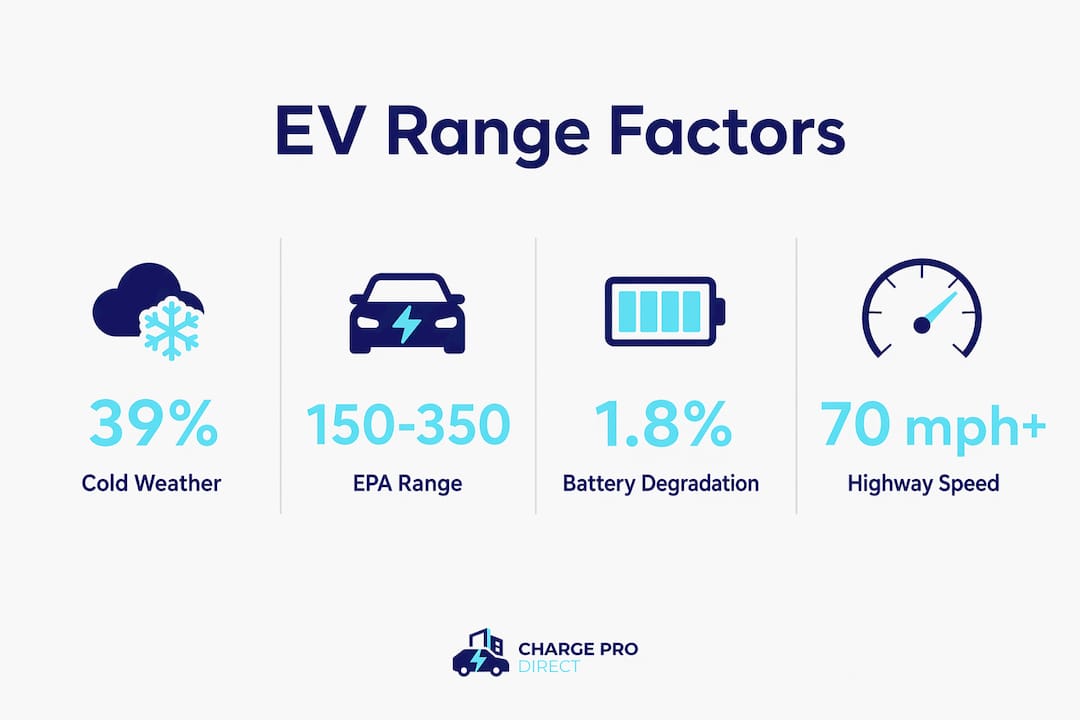
Most modern EVs deliver between 150 and 350 miles of EPA-rated range per charge. The EPA rating is the industry standard benchmark, but it is a controlled-test number. Real-world range varies with driving style, cargo weight, weather, and how you use your climate control system.
Entry-level EVs like the Nissan Leaf sit at the lower end, around 150–212 miles depending on trim. Mid-range options like the Chevrolet Equinox EV and Ford Mustang Mach-E land in the 250–300 mile zone. Long-range models from Tesla, Rivian, and Mercedes-Benz push past 300 miles, with some Tesla Model S configurations rated above 400 miles.

The key takeaway is that electric vehicle mileage is not a fixed number. It is a range within a range. Plan your EV choice around the lower end of what a model delivers, not the headline figure on the window sticker.
Temperature is the single biggest variable in real-world electric car range. Cold temperatures reduce EV range by about 39% compared to moderate conditions. Hot temperatures cause about an 8.5% reduction. That asymmetry surprises most buyers.
Here is why cold hits so hard. Lithium-ion batteries lose chemical efficiency below freezing, and the cabin heater draws heavily from the same battery pack that powers the motor. A 300-mile EPA-rated EV could realistically deliver around 180 miles on a cold winter day with the heat running. AAA testing at 20°F confirmed average range cuts of 39–41% when cabin heat is on. That is not a flaw. It is physics you can plan around.
Beyond temperature, these factors cut into electric vehicle mileage:
Pro Tip: Use your EV’s built-in energy consumption display to track real-world efficiency in miles per kilowatt-hour (kWh). This number tells you more about your actual range than the EPA sticker ever will.
Estimating your usable electric car range starts with your daily mileage, not the car’s maximum. The EPA frames range as a fit question, and the data supports that framing. Nine in ten single-car households travel 70 miles or less on a typical day. That puts most daily driving well within the capability of even shorter-range EVs.
Think in daily mileage blocks rather than maximum single-trip distance. Here is a practical way to assess fit:
The EPA notes that real-world range varies widely with driving style, cargo, and weather. Treat the EPA number as your ceiling, not your guarantee. Our EV charging savings calculator can also help you model the cost side of your daily driving block.
Range varies significantly across EV segments. Battery size and efficiency both matter. A larger battery pack does not always mean more range if the vehicle is heavier or less aerodynamic. The table below shows approximate EPA-rated ranges for well-known models across segments.
| Model | Segment | Approx. EPA Range |
|---|---|---|
| Nissan Leaf (40 kWh) | Entry-level | ~150 miles |
| Chevrolet Bolt EV | Compact | ~259 miles |
| Ford Mustang Mach-E (Standard) | Mid-size SUV | ~250 miles |
| Hyundai Ioniq 6 (Long Range RWD) | Sedan | ~361 miles |
| Tesla Model 3 (Long Range RWD) | Sedan | ~358 miles |
| Rivian R1T (Max Pack) | Truck | ~410 miles |
Entry-level models work well for urban drivers with reliable home charging. Long-range models from Tesla, Hyundai, and Rivian suit drivers in cold climates or those who regularly take longer trips. Climate region matters as much as the range number itself. A 250-mile EV in Miami performs very differently from the same vehicle in Chicago in january.
For buyers in colder states, prioritizing a model with at least 250 miles of EPA range gives you a realistic 150+ miles of usable range on the coldest days. That buffer removes most range anxiety from daily driving.
Getting the most from your EV’s range requires a few consistent habits. None of them are complicated, but they add up meaningfully over time.
Pro Tip: If your EV supports it, plug in every night at home even when the battery is not low. Consistent, partial charging is gentler on battery chemistry than occasional deep discharge cycles.
Our home EV charger guide walks through the charger types that support these habits best, including Level 2 options that fully recharge most EVs overnight.
Most EVs deliver 150–350 miles of EPA-rated range, but real-world electric vehicle mileage depends on temperature, driving habits, and battery health, so plan around your climate and daily mileage block rather than the headline number.
| Point | Details |
|---|---|
| EPA range is a ceiling | Real-world range runs lower due to weather, speed, and load. |
| Cold weather cuts range sharply | AAA testing shows up to 39% range loss at 20°F with cabin heat on. |
| Daily mileage fits most EVs | Nine in ten households drive 70 miles or less daily, within most EV ranges. |
| Battery degradation is gradual | At 1.8% loss per year, range stays strong for 10–15 years with proper care. |
| Home charging solves most range concerns | Overnight Level 2 charging gives you a full battery every morning. |
Most range anxiety comes from comparing an EV to a gas car the wrong way. With a gas car, you think about how far you can go before you need to stop. With an EV and home charging, you think about how far you go before you get home. That mental shift changes everything.
For many drivers with home charging, range becomes much less of a concern once overnight charging is routine. The battery is full every morning without a trip to a gas station, and the anxiety tends to fade.
Where range genuinely matters is in cold climates and on road trips. If you live in a state that regularly sees temperatures below 20°F, a 200-mile EPA-rated EV may leave you with 120 usable miles on the worst days. That is still enough for most commutes, but it requires honest planning. Buyers in cold regions should prioritize models with 250 miles or more of EPA range and invest in a reliable Level 2 home charger that supports preconditioning.
The other thing most articles underplay is how much driving style matters. The same EV model can deliver very different range depending on who is driving it. Speed, smoothness, and heat management are the real controls. The car gives you the tools. How you use them determines your actual range.
Range is ultimately a fit question, not a performance contest. Match the vehicle to your climate, your commute, and your charging setup. Get those three things right, and range becomes a non-issue.
Reliable home charging is the foundation of stress-free EV ownership. When your car charges fully overnight, range concerns largely disappear before your day even starts.

Chargeprodirect carries the EVIQO Level 2 EV Charger (48A, 240V, hardwired) and the EVIQO 48A NEMA 14-50 plug-in model, both compatible with J1772 non-Tesla EVs and capable of fully recharging most vehicles overnight. On a NEMA 14-50 outlet, set the plug-in model to 40A. The full 48A requires hardwiring on a 60A circuit. Not sure which charger fits your EV and electrical setup? Use the EV charger finder on the Chargeprodirect website to get a matched recommendation in minutes. Residential EV chargers ship free, and flexible payment plans are available at checkout.
Most modern EVs travel between 150 and 350 miles on a full charge based on EPA ratings. Long-range models from Tesla, Hyundai, and Rivian exceed 350 miles under ideal conditions.
Cold temperatures reduce EV range by approximately 39% compared to moderate conditions, according to AAA testing at 20°F. A 300-mile EPA-rated EV may deliver around 180 miles on a cold winter day with cabin heat running.
EV battery degradation averages about 1.8% per year, and batteries generally last 15–20 years with proper care. Most drivers see only modest range loss over the first decade of ownership.
Yes, significantly. Highway speeds above 70 mph, hard acceleration, and heavy cargo all reduce electric vehicle mileage. Smooth driving at moderate speeds can extend real-world range by 20–30% compared to aggressive driving.
For most American households, yes. The EPA notes that nine in ten single-car households travel 70 miles or less per day, putting a 200-mile EV well within daily needs even after accounting for cold-weather range loss.