
Need Installation?
Book a licensed install
Book a licensed EV charger install

Whole home solar battery sizing is the process of calculating the exact battery capacity (measured in kWh) and power output (measured in kW) your household needs to run reliably on stored solar energy. Get it wrong in either direction and you either run out of power during an outage or spend thousands on storage you never use. The average U.S. household used approximately 865 kWh per month in 2024, which translates to roughly 29 kWh per day. That single number is your starting point for every sizing decision that follows. Popular systems like the Tesla Powerwall 3, LG 16H Prime, and Enphase IQ Battery each approach whole home energy storage differently, and choosing between them starts with knowing your actual load requirements.
Your electric bill is the most accurate data source you have. Find your monthly kWh total on the bill, then divide by 30 to get your daily average. A home using 900 kWh per month needs about 30 kWh per day. That number becomes the foundation of your entire residential solar battery guide.
The next step is deciding what you actually want to back up. There is a significant difference between powering your whole home and powering only the essentials. Backup needs vary widely: essentials only (lights, fridge, phone charging) require roughly 5 to 8 kWh per day, while a whole home without air conditioning needs 20 to 25 kWh daily. Add central HVAC and that range jumps to 15 to 20 kWh for a partial backup or 24 to 30 kWh for full coverage.

Here is a simple load estimate table to help you visualize your daily consumption:
| Appliance | Avg. Daily Usage (kWh) |
|---|---|
| Refrigerator | 1.5 |
| Central AC (8 hrs) | 12.0 |
| Lighting (whole home) | 2.0 |
| EV charging (overnight) | 9.6 |
| Washer + dryer | 3.5 |
| Total (example home) | 28.6 |
If you want a more precise picture, a home energy monitor like Sense or Emporia Vue tracks real-time consumption by circuit. That level of detail removes guesswork and often reveals that one or two appliances are responsible for a disproportionate share of your daily load.
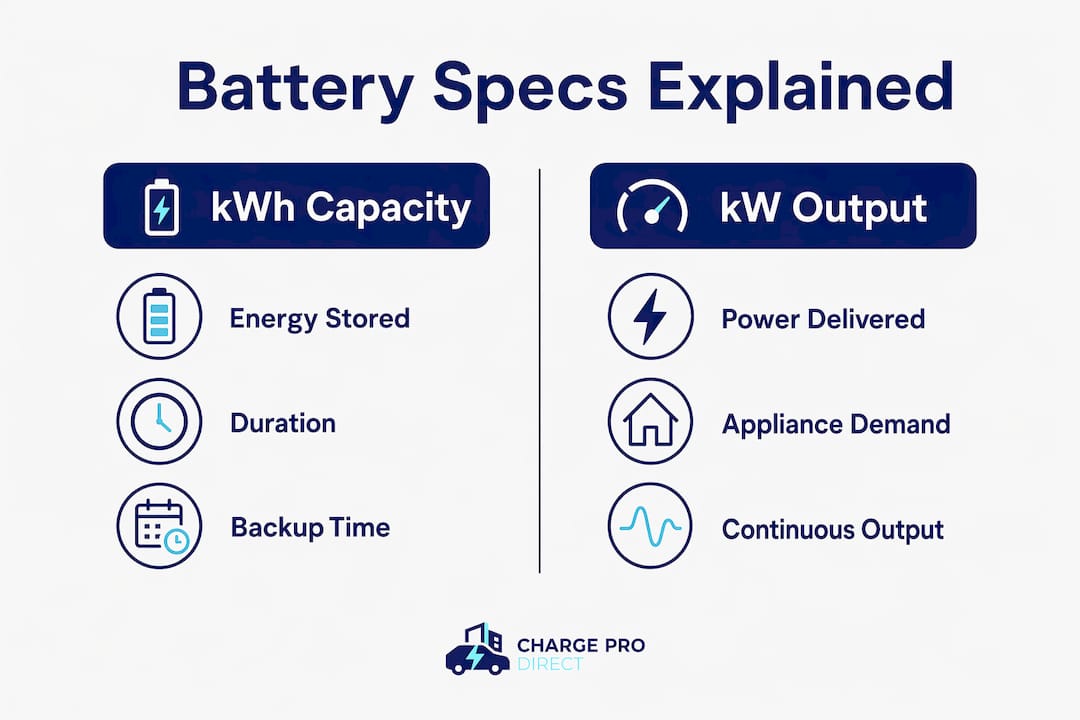
Most homeowners focus entirely on kWh (kilowatt-hours) and overlook kW (kilowatts). This is one of the most common and costly misunderstandings in battery storage for solar. kWh tells you how long the battery lasts. kW tells you how much it can power at once.
Think of it this way: a battery with 13.5 kWh of storage but only 5 kW of output cannot run a 3-ton central air conditioner (which draws roughly 3.5 kW) and a dishwasher (1.2 kW) and a refrigerator (0.15 kW) at the same time. The math on capacity works, but the output ceiling causes the system to trip. Battery output must equal or exceed your home’s peak demand to avoid breaker trips or appliance failures.
Here is how output requirements break down by backup scope:
| Backup Scope | Required Output (kW) | Example Battery |
|---|---|---|
| Essentials only | 3 to 5 kW | Tesla Powerwall 3 (5 kW) |
| Whole home, no EV | 8 to 12 kW | LG 16H Prime (stacked) |
| Whole home + EV charging | 12+ kW | Sol-Ark 15K system |
The Tesla Powerwall 3 delivers 13.5 kWh of usable storage with 5 kW continuous output. That is enough for essentials backup but falls short for whole home coverage unless you stack two or more units. The LG 16H Prime provides 16 kWh at 400V high voltage, making it a strong candidate for homes that need more capacity per unit. Enphase IQ Battery systems are modular, letting you add capacity incrementally as your needs grow.
Pro Tip: When comparing battery specs, always check both the continuous output rating and the peak (surge) output. Some batteries list a higher surge rating that only lasts a few seconds. Your HVAC compressor needs sustained output, not a brief spike.
Days of autonomy refers to how many consecutive days your battery can power your home without any solar input. For most homeowners, one to three days covers the vast majority of outage scenarios. Longer autonomy is worth planning for if you live in a region with frequent multi-day storms or limited grid reliability.
The core formula for calculating total stored energy needed is straightforward:
Total Stored Energy (kWh) = Daily Energy Use × Days of Autonomy
For a home using 28 kWh per day that wants two days of backup: 28 × 2 = 56 kWh of gross storage. But you cannot use 100 percent of a battery’s rated capacity without damaging it. Most lithium iron phosphate (LFP) batteries allow an 80 to 90 percent depth of discharge (DoD). Factor in a system efficiency of around 90 percent and the full sizing formula becomes:
Required Ah = (Total Daily Wh × Days of Autonomy) / (System Voltage × DoD × System Efficiency)
Solar recharging changes the equation significantly. If your panels generate 20 kWh on a typical sunny day and your home uses 28 kWh, you only need 8 kWh of net storage to bridge the gap. With solar recharging, 25 to 40 kWh of installed capacity can realistically provide three or more days of autonomy for most households. That is why sizing your solar array and your battery together matters more than sizing either one in isolation.
Pro Tip: Do not size for your worst-case winter week if you live in Arizona. Match your autonomy target to your actual climate and outage history. Oversizing for rare events adds cost without adding meaningful reliability.
Getting the size wrong is more common than most installers admit. Here are the mistakes that show up repeatedly, and what to do instead.
“Right-sizing a battery system is not just math. It is a strategic exercise that combines load management, solar generation timing, and realistic autonomy planning.”, Solar Battery Sizing Guide, Anern
Follow these seven steps and you will arrive at a defensible, accurate battery size before you talk to a single installer.
Here is a quick home solar battery sizing checklist to use before you purchase:
| Sizing Step | What to Confirm |
|---|---|
| Daily energy use | Calculated from peak monthly bill, not annual average |
| Backup scope | Whole home, essentials, or EV-inclusive |
| Autonomy days | Matched to local climate and outage frequency |
| Gross storage (kWh) | Adjusted for DoD and system efficiency |
| Output power (kW) | Exceeds total simultaneous peak load |
| Installation site | Meets ventilation, clearance, and code requirements |
For a deeper look at how your battery pairs with your solar panels, the solar panel battery pairing guide at Chargeprodirect walks through the integration side of the equation in detail. You can also explore complete solar kits that bundle panels, inverter, and battery together if you are starting from scratch.
Accurate whole home solar battery sizing requires calculating both kWh capacity and kW output against your real daily load, autonomy target, and solar recharge rate.
| Point | Details |
|---|---|
| Start with peak daily use | Use your highest monthly bill divided by 30, not your annual average. |
| Match output to peak load | Your battery’s continuous kW rating must cover all simultaneous appliances. |
| Apply the autonomy formula | Multiply daily use by autonomy days, then adjust for DoD and efficiency. |
| Solar recharge reduces storage needs | Paired solar generation can cut required battery capacity by 30 to 50 percent. |
| Avoid installation oversights | Ventilation, fire clearances, and code compliance are required, not optional. |
One of the most consistent mistakes in battery sizing is treating the kWh number as the only number that matters. A homeowner buys a 13.5 kWh battery, feels confident, and then discovers during the first outage that the HVAC and refrigerator cannot run at the same time because the output ceiling is too low. The capacity was fine. The output was the problem.
EV charging also changes the math considerably. A homeowner who drives 40 miles a day and charges overnight is adding roughly 12 to 15 kWh of nightly demand. That is almost half a second battery. If you own or plan to own an electric vehicle, size your battery system for that load from the start. Retrofitting later is expensive and sometimes requires a full system redesign.
Be cautious about the instinct to overbuy on autonomy. Three days of whole home backup sounds reassuring, but for most suburban homeowners in the continental U.S., it represents a significant cost premium for a scenario that may never occur. Two days of autonomy with a well-sized solar array covers the overwhelming majority of real outage events. Spend the savings on a higher-output battery instead of more raw capacity.
One more thing: smart load management is underused. Shifting your EV charge, dishwasher, and dryer to midday solar hours can reduce your required battery capacity by a meaningful amount. That is not a workaround. It is good system design.
If you have worked through the sizing steps above and are ready to match your numbers to real products, Chargeprodirect has you covered.

Chargeprodirect carries the LG 16H Prime battery for high-voltage whole home storage, the Sol-Ark 15K whole home bundle for homes that need 32 kWh and serious output power, and a full range of home battery backup systems sized for every scenario. If your system includes EV charging, the EVIQO Level 2 EV Charger (40A, 9.6kW) integrates cleanly with solar battery setups and supports J1772 non-Tesla vehicles. Residential EV chargers ship free, and flexible payment plans are available at checkout.
Most whole home battery systems require 24 to 30 kWh for one day of backup without solar recharging. With a solar array generating 15 to 20 kWh daily, 25 to 40 kWh of installed capacity can provide three or more days of autonomy.
kWh (kilowatt-hours) measures how much total energy the battery stores, while kW (kilowatts) measures how much power it can deliver at one moment. A battery can have plenty of storage but still fail to run your home if its kW output rating is too low for your peak load.
Multiply your daily energy use (in kWh) by your target autonomy days, then divide by your battery’s depth of discharge and system efficiency. Subtract expected daily solar generation to find the net storage you actually need to purchase.
Yes, significantly. An EV charging overnight at 9.6 kW adds roughly 9 to 15 kWh of nightly demand depending on charge duration. Include that load in your daily energy total before applying any sizing formula.
Smart controllers and timers that shift heavy appliance use to peak solar hours can meaningfully reduce required battery capacity. Running your dryer and dishwasher at noon instead of midnight means your battery stores less and lasts longer.