
Need Installation?
Book a licensed install
Book a licensed EV charger install

A battery backup system is defined as a device that stores electricity in advance and automatically delivers it to your home or business the moment grid power fails. Unlike a gas generator, it produces no exhaust, makes no noise, and requires no manual startup. Systems like the Tesla Powerwall and LG Chem RESU have made this technology accessible to homeowners and small businesses across the country. Understanding why battery backup is needed during outages comes down to one fact: the grid is less reliable than most people assume, and the consequences of being unprepared are real.
A battery backup stores electricity from either the utility grid or solar panels and releases it automatically when the grid goes down. The switch happens through an automatic transfer switch, which detects the outage and reroutes power from the battery to your circuits within milliseconds. You never touch a button. The lights stay on.
Here is how the two main system types differ:
Runtime depends on how many appliances you power and the battery’s capacity, measured in kilowatt-hours (kWh). A 10 kWh battery running only a refrigerator, a few lights, and phone chargers can last 24 hours or more. Running an HVAC system cuts that time significantly.
Pro Tip: Before an outage hits, list every device you consider essential. Add up their wattage to estimate your daily energy need. That number tells you the minimum battery capacity to shop for.

Generators have been the default backup option for decades, but battery backups outperform them in several categories that matter most to homeowners and small businesses.
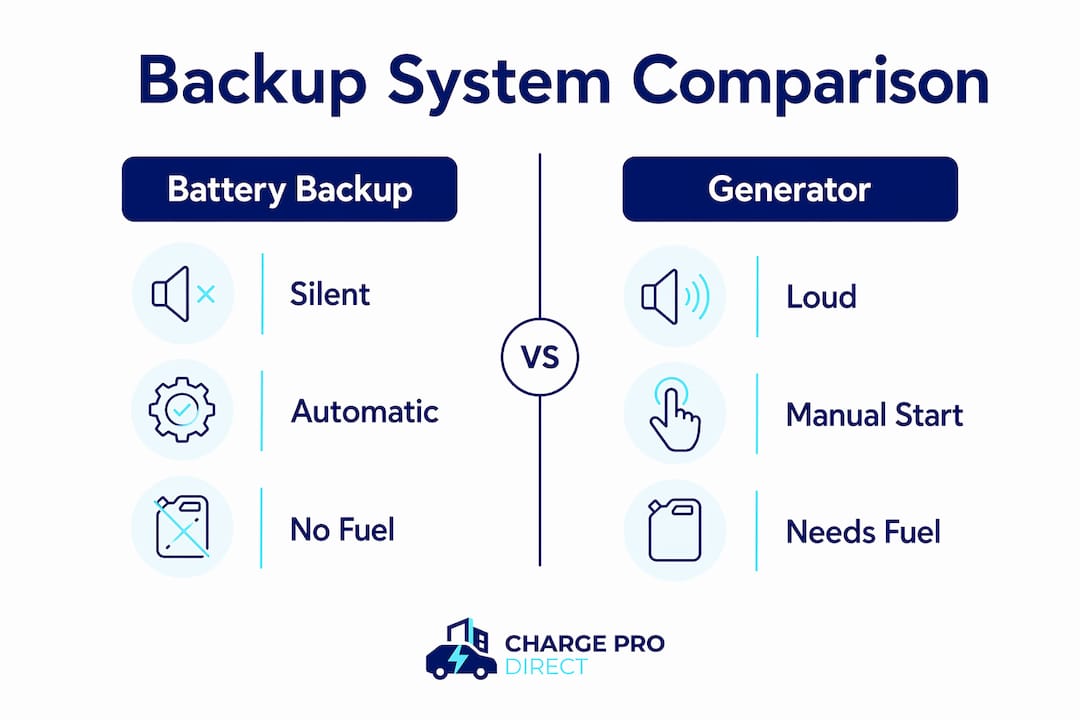
| Feature | Battery Backup | Fuel Generator |
|---|---|---|
| Noise level | Silent | 65–75 decibels (lawn mower level) |
| Startup | Automatic, instant | Manual or auto-start with fuel |
| Fuel required | None (grid or solar charged) | Gasoline, propane, or natural gas |
| Exhaust/emissions | Zero | Carbon monoxide risk indoors |
| Maintenance | Minimal | Regular oil changes, fuel storage |
| Grid integration | Yes, charges from grid or solar | No |
| Indoor safety | Safe | Never safe indoors |
Solar plus battery storage provides quiet, automatic backup that can also reduce your monthly electric bill through time-of-use optimization. That dual benefit makes the investment easier to justify.
The benefits of battery backup go beyond convenience. For a small business, a generator requires someone on-site to start it, monitor fuel levels, and manage exhaust ventilation. A battery backup does none of that. It just works. For a home with children, elderly residents, or anyone with a medical condition, that reliability is not optional.
The importance of battery backup becomes clearest when you think through what actually stops working the moment power fails.
Medical devices. Oxygen concentrators, CPAP machines, home dialysis equipment, and insulin refrigerators all require uninterrupted power. Devices like these benefit from clean, uninterrupted power and protected shutdown protocols that battery backups provide. A sudden outage can cause equipment damage or, worse, a health emergency.
Food safety. A full freezer stays safe for up to 48 hours without power; a refrigerator stays safe for only 4 hours if kept closed. That is a narrow window. Battery backup keeps your refrigerator running and eliminates the guesswork entirely.
Communications and lighting. During an emergency, your phone, router, and lighting are not luxuries. They are how you get information, call for help, and stay safe. A battery backup for power outages keeps these running without any action on your part.
Business continuity. A retail shop, medical office, or restaurant that loses power loses revenue and potentially customers. Point-of-sale systems, security cameras, refrigerated inventory, and lighting all depend on continuous power. Even a two-hour outage during peak hours can cost hundreds or thousands of dollars.
HVAC and temperature control. In extreme heat or cold, losing climate control is a health risk, not just a discomfort. Battery backup keeps fans, space heaters, or central systems running long enough to matter.
“Public Safety Power Shutoffs (PSPS) can affect tens of thousands of customers at once. A May 2026 PSPS event impacted over 46,000 customers, with outages lasting longer than most households planned for. Backup systems sized for worst-case scenarios are the only reliable answer.”
The health and safety risks from outages are a strong motivator for adopting battery backups beyond mere convenience. Waiting until the next outage to realize you needed one is a costly mistake.
Choosing the right system starts with knowing your load. Load is the total wattage of every device you need to keep running during an outage.
| Household Size | Estimated Critical Load | Recommended Battery Capacity |
|---|---|---|
| Small apartment | 500–800W | 5–10 kWh |
| Medium home | 1,000–1,500W | 10–15 kWh |
| Large home or small business | 2,000–3,000W | 20–30 kWh |
Some states and utilities offer rebates for battery storage. Check your utility and state energy office for current programs before you buy.
Pro Tip: If you have a medical device in your home, contact your utility company and register as a medical baseline customer. Some utilities prioritize restoration for these accounts, but a battery backup is still your most reliable protection.
Homes with reliable backup recover faster and sustain less damage after grid disruptions. Battery backup is a resilience investment, not just a convenience purchase.
Battery backup systems are the most reliable way to protect your home or small business from the health, financial, and safety consequences of power outages.
| Point | Details |
|---|---|
| Automatic protection | Battery backups switch on instantly with no manual action required during an outage. |
| Solar extends runtime | A battery-only system is a finite reserve; pairing with solar recharges it daily for multi-day coverage. |
| Safety is the top priority | Medical devices, refrigerated medicine, and food safety all depend on uninterrupted power. |
| Size for worst-case outages | Plan for at least 24 hours of critical load coverage, not just the average outage duration. |
| Rebates may reduce costs | Check with your state and utility for available battery storage rebates. |
Most people buy a battery backup after their first bad outage. That is understandable, but it means they spent the previous outage losing food, scrambling for flashlights, and worrying about a family member’s medical device. The planning should happen before the grid fails, not after.
The most common mistake is underestimating load. Someone buys a 5 kWh battery thinking it will cover their home, then discovers it runs out in six hours because they forgot about the refrigerator, the router, and the hallway lights all running simultaneously. Sizing matters more than brand.
The second mistake is treating a battery-only system as equivalent to a solar-plus-storage system. They are not the same. A battery without solar is a one-time reserve. If your outage lasts three days, you are out of power after day one. Pairing with solar changes the math entirely, because the battery refills every sunny day. That is real resilience.
The third thing most articles skip is the value of reducing grid dependence year-round, not just during outages. A well-sized battery system charges during off-peak hours when electricity is cheap and discharges during peak hours when it is expensive. That behavior cuts your monthly bill even when the grid is working fine.
The grid is not getting more reliable. Extreme weather events are more frequent, and aging infrastructure means more unplanned outages. A battery backup is not a luxury purchase anymore. For most homeowners and small businesses, it is the most practical energy decision you can make right now.
If you are ready to stop guessing and start planning, Chargeprodirect makes it straightforward. Our product pages list capacity and specs so homeowners and small businesses can compare options for the right home battery backup based on actual load, outage history, and budget. No overselling, no undersizing.
Chargeprodirect carries whole-home battery systems, solar generators, and complete solar kits that pair storage with panels for multi-day outage coverage. Products like the Canadian Solar EP Cube and the Midnite Power MNPowerflo5 are available with flexible payment plans. If you also drive an EV, consider an EVIQO Level 2 EV charger that works alongside your backup system for a complete home energy setup. Residential EV chargers ship free.
A home battery backup is a device that stores electricity from the grid or solar panels and automatically powers your home during an outage. Systems like the Tesla Powerwall and Canadian Solar EP Cube are common residential options.
Runtime depends on battery capacity and the devices you power. A 10 kWh battery covering only critical loads like a refrigerator, lights, and phone chargers can last 24 hours or more.
Battery backups activate automatically, produce no exhaust, and require no fuel or maintenance. Generators are louder, require manual operation, and pose carbon monoxide risks indoors.
No, but solar significantly extends your coverage. A battery without solar is a finite reserve that only recharges when the grid returns. Solar recharges it daily, even during extended outages.
Start by listing your critical devices and their wattage, then multiply by the hours you need them to run. Most medium-sized homes need 10–15 kWh to cover essential loads for 24 hours.