
Expert Support
Mon–Fri, 9AM–6PM EST
Available: Mon–Fri, 9AM–6PM EST
Mon–Fri, 9AM–6PM EST
Available: Mon–Fri, 9AM–6PM EST

Home battery backup EV pairing is the process of connecting a residential battery storage system with your electric vehicle charging setup to create reliable backup power, lower energy costs, and greater independence from the grid. This approach uses Vehicle-to-Home (V2H) technology, which lets a compatible EV send stored electricity back into your house during an outage. Federal tax credits of 30% up to $1,000 are available through june 30, 2026, making now a practical time to act. Chargeprodirect helps homeowners size, select, and configure the right equipment for this kind of setup without the guesswork that leads to costly pre-installation mistakes.
A complete home battery backup EV pairing setup has four core components: a bidirectional charger, a home battery system, a compatible EV, and a transfer switch. Each one plays a specific role, and skipping any of them creates a gap in your backup capability.
Bidirectional chargers are the heart of V2H. Unlike a standard Level 2 charger that only pushes power into your car, a bidirectional unit moves electricity in both directions. Full V2H system costs typically run between $6,500 and $14,000, including the transfer switch and isolation hardware. That price reflects the added complexity of safely routing power back into your home’s circuits.
EV compatibility is the factor most homeowners overlook. Your EV needs an onboard bidirectional inverter to participate in V2H. Without one, you need external hardware that adds $2,000 to $3,000 beyond the charger cost. Check your vehicle’s spec sheet before budgeting.
Dedicated home battery systems in the 5–10 kWh range serve as a buffer. They cover your home when your EV is parked elsewhere, and they absorb the daily micro-cycling that would otherwise wear down your car’s battery faster.
Transfer switches are not optional. NEC Article 702 classifies V2H as an “optional standby system” and requires strict safety isolation through automatic transfer switches or mechanical interlocks. This prevents dangerous back-feeding to the grid, which protects utility workers during outages.
Here is a quick comparison of the main equipment categories:
| Component | Purpose | Typical Cost Range |
|---|---|---|
| Bidirectional EV charger | Moves power to and from EV | Included in $6,500–$14,000 bundle |
| Home battery (5–10 kWh) | Covers gaps when EV is away | Varies by brand and capacity |
| Transfer switch | Safety isolation per NEC Article 702 | Included in full system bundle |
| External bidirectional inverter | Required if EV lacks onboard inverter | $2,000–$3,000 additional |
Pro Tip: Before purchasing any bidirectional charger, confirm your EV model has a factory-installed bidirectional inverter. This single check can save you thousands of dollars in added hardware costs.
Solar panels are a strong addition to this setup. Combining solar with home battery storage and EV integration maximizes clean energy use and extends how long your home can run without grid power. A solar panel pairing guide can help you size panels correctly for your total energy load.
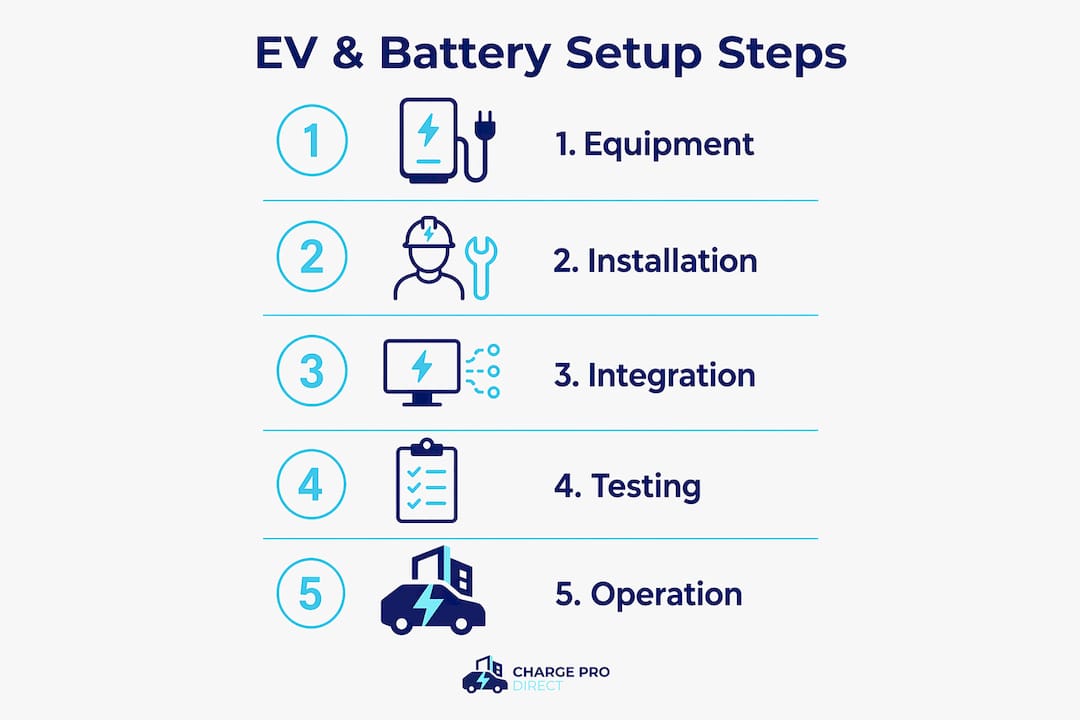
Installation follows a clear sequence. Rushing any step creates safety risks and can void permits or warranties.
Assess your electrical panel. Check whether your panel has capacity for both a bidirectional charger and a home battery. Many homes can avoid expensive panel upgrades by using smart splitters or load-shedding devices, which can reduce installation costs by $1,500 to $4,000. These devices manage multiple high-load circuits within your existing panel capacity.
Pull permits before touching hardware. Every jurisdiction requires permits for this type of work. Standard home EV charger installation costs run $1,200 to $3,500 for hardware and labor before any battery integration. Adding a home battery and transfer switch increases that figure. Your local building department sets the inspection schedule.
Choose hardwired or plug-in charger installation. A hardwired bidirectional charger delivers the most stable connection and is the standard choice for V2H. A plug-in charger using a NEMA 14-50 outlet offers more flexibility but may limit maximum power output. Your panel capacity and daily driving habits determine which fits better.
Install the transfer switch and safety interlocks. This step requires a licensed electrician in most states. The transfer switch physically disconnects your home from the grid before the EV or battery can supply power. This is the safety mechanism that NEC Article 702 mandates.
Mount and wire the home battery system. Position the battery in a climate-controlled space away from direct sunlight and extreme temperatures. Connect it to the same subpanel as your bidirectional charger so both systems can coordinate load sharing.
Configure the energy management system. Most modern systems include a smart controller or app that lets you set charging schedules, backup thresholds, and solar priority rules. Set your EV charging to off-peak hours to reduce electricity costs under time-of-use utility rates.
Pro Tip: Ask your installer specifically about dark start capability before signing any contract. A bidirectional charger without this feature cannot initialize power flow during a total grid outage, which defeats the purpose of the whole setup.
The full process from permit application to final inspection typically takes 1 to 3 weeks. Factor that timeline into your planning, especially if you live in a region with frequent storm outages.
You can review a detailed breakdown of what drives costs up or down in Chargeprodirect’s EV charger installation guide for homeowners.
Your EV battery is a powerful backup resource, but it has firm limits you need to plan around.
A typical home uses roughly 30 kWh per day. A 100 kWh EV battery can cover about 3 days of normal household use. Under load shedding, where you cut non-essential circuits, that same battery can stretch to 14 days. That range is wide because it depends entirely on which appliances you keep running.
Key fact: V2H is best used as emergency backup or peak-shaving tool, not as a permanent off-grid solution. A dedicated home battery remains essential for covering the hours your EV is parked at work or elsewhere.
The hybrid approach solves the “car is away” problem. A 5–10 kWh home battery handles your overnight and daytime loads when the EV is not plugged in. When the EV returns, it recharges the home battery and takes over as the primary backup source. The two systems work as a team, not as alternatives.
Running both systems simultaneously is feasible. Charging an EV and home battery at the same time typically draws 5–7 kW, which most properly designed circuits can handle. Smart energy management systems use timers and load monitoring to prevent circuit overloads during simultaneous charging.
Here are the key operational realities to keep in mind:
Most problems with paired systems come from one of three sources: hardware incompatibility, poor load management, or skipped maintenance steps.
Hardware compatibility is the first thing to verify before any purchase. Not every EV works with every bidirectional charger. Confirm that your charger uses the J1772 or CCS standard your vehicle accepts, and verify that your EV’s onboard software supports V2H discharge. Firmware mismatches between the charger and vehicle can block bidirectional operation entirely.
Pro Tip: Sign up for firmware update notifications from both your EV manufacturer and your charger brand. A single missed update can disable V2H functionality until the software versions are back in sync.
The home EV charging setup guide from Chargeprodirect covers panel capacity planning in detail, which is useful if you are still in the assessment phase.
A properly paired home battery and EV system delivers reliable backup power, lower energy costs, and reduced grid dependence when every component is correctly sized and installed.
| Point | Details |
|---|---|
| V2H requires specific hardware | Your EV needs a bidirectional inverter; missing one adds $2,000–$3,000 in external hardware costs. |
| NEC Article 702 compliance is mandatory | Transfer switches and safety interlocks are legally required, not optional upgrades. |
| Home battery fills the coverage gap | A 5–10 kWh dedicated battery covers your home when the EV is away or charging elsewhere. |
| Dark start capability is critical | Without it, your bidirectional charger cannot activate during a total grid outage. |
| Solar extends backup duration | Adding solar panels reduces grid dependence and recharges your home battery during the day. |
People come to V2H expecting their EV to replace a whole-home generator. That expectation sets them up for disappointment. After working through dozens of home energy setups, the pattern is clear: the homeowners who get the most value from this technology are the ones who treat the EV as the second layer, not the first.
A dedicated home battery handles the predictable, daily load. The EV handles the big emergencies, the multi-day outages, the situations where you need serious capacity fast. When you build the system that way, EV battery degradation drops, backup coverage becomes consistent, and the math on return-on-investment actually works out.
The other thing most articles skip is the dark start issue. I have seen homeowners spend $10,000 on a V2H setup only to discover their charger cannot initialize during a real outage because it lacks dark start capability. That is not a minor footnote. It is the difference between a system that works when the power goes out and one that sits idle exactly when you need it most.
My honest recommendation: start with a quality home battery in the 10–16 kWh range, add a bidirectional charger only after confirming your EV supports it natively, and integrate solar when your budget allows. That sequence gives you real resilience at every stage, not just on paper.
Clarissa
Chargeprodirect carries the hardware you need to build a complete residential energy system, from high-power Level 2 chargers to whole-home battery bundles.

The EVIQO 48A hardwired Level 2 charger delivers up to 50A at 240V and is built for homeowners integrating EV charging with a home battery system. For whole-home resilience, the Sol-Ark 15K whole-home backup bundle pairs a 15kW inverter with 32 kWh of battery storage. Not sure which charger fits your EV and panel setup? Use the EV Charger Finder to get a matched recommendation in minutes. Chargeprodirect’s team reviews your power situation before you buy, so you select the right equipment the first time.
Home battery backup EV pairing connects a residential battery system with your EV charging setup so the two can share and supply power during outages or peak-rate periods. V2H technology enables the EV battery to send electricity back into your home when needed.
No. Your EV must have a factory-installed bidirectional inverter to support V2H natively. Without one, external hardware costing $2,000 to $3,000 is required to enable the same function.
A 100 kWh EV battery covers roughly 3 days of typical home use at about 30 kWh per day. Under load shedding, that same battery can last up to 14 days.
Yes. NEC Article 702 classifies V2H as an optional standby system and mandates safety isolation through an automatic transfer switch or mechanical interlock to prevent back-feeding to the grid.
Yes, with proper circuit design. Simultaneous charging typically draws 5–7 kW, which a correctly wired system handles safely. Smart energy management systems use timers and load monitoring to coordinate both without overloading your panel.