
Need Installation?
Book a licensed install
Book a licensed EV charger install

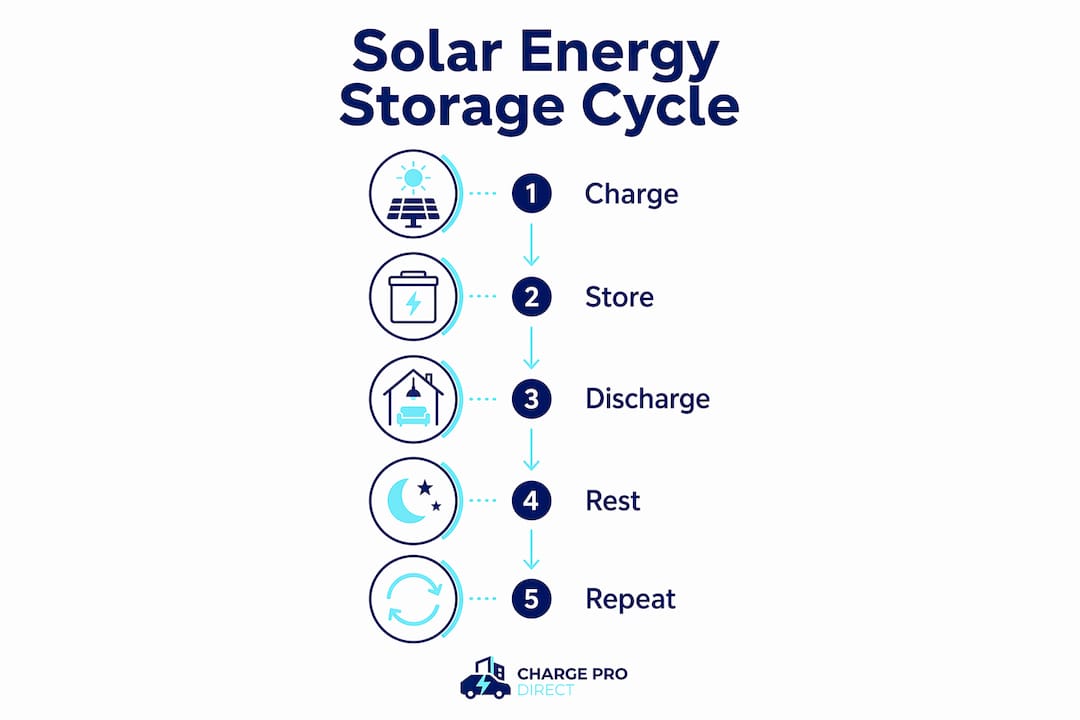
A solar energy storage cycle is the complete process of charging a battery with solar-generated electricity and then discharging that stored energy when solar output drops. Think of it like a rechargeable battery in your phone. Your solar panels fill the battery during the day, and you draw from it at night or during cloudy weather. The U.S. Department of Energy defines this charge and discharge behavior as the foundation of any solar storage system. Understanding what is solar energy storage cycle mechanics means you can size your system correctly, extend battery life, and get the most value from every kilowatt-hour you store.
A full storage cycle equals one complete charge from 0% state of charge (SOC) to 100%, followed by a full discharge back to 0%. That is the textbook definition. In real solar systems, though, batteries rarely swing through that full range.
Most residential and commercial systems cycle between 20% and 90% SOC to reduce stress on the cells. Because of this, the industry uses full equivalent cycles (FEC) as the standard metric. FEC adds up all your partial charges and discharges and converts them into the equivalent number of full 0–100% cycles. This gives you a realistic picture of how much life you have used.
Pro Tip: Assuming one day equals one full cycle is a common sizing mistake. Your actual FEC count depends on how deeply you discharge each day. Shallow daily swings of 20–30% SOC accumulate to far fewer equivalent cycles than deep 80% swings.
Depth of discharge (DoD) is the percentage of total capacity you use in a single cycle. A 10 kWh battery discharged to 80% DoD uses 8 kWh. Higher DoD per cycle means faster cycle count accumulation and faster wear. Partial cycling strategies reduce cycle fatigue, but they do not eliminate degradation entirely because calendar aging continues regardless.
Battery degradation follows two parallel paths: cycle aging and calendar aging. Cycle aging results from the physical and chemical stress of each charge and discharge event. Calendar aging happens over time regardless of whether you use the battery at all. Both degrade capacity and shorten the usable life of your system.
The industry standard for end of cycle life is 80% capacity retention. When your battery can only hold 80% of its original rated capacity, it has reached the end of its warranted cycle life. Most manufacturers guarantee at least 70% retention after 10 years. The battery still works after that point. It just holds less energy per charge.
Temperature and SOC level both accelerate degradation. Storing a battery at high SOC (above 90%) for extended periods stresses the cells even without cycling. High ambient temperatures speed up the chemical reactions that cause capacity loss. A battery stored at 95°F degrades measurably faster than one kept at 77°F.
Pro Tip: If your system sits idle for weeks, set the battery to rest at 50–60% SOC rather than fully charged. This single habit reduces calendar aging significantly over the life of the system.
| Degradation Type | Cause | Mitigation |
|---|---|---|
| Cycle aging | Repeated charge and discharge events | Limit DoD, use partial SOC windows |
| Calendar aging | Time-based chemical breakdown | Store at moderate SOC, control temperature |
| Temperature stress | Heat accelerates cell chemistry | Install in shaded, ventilated spaces |
| High SOC storage | Sustained full charge strains cells | Avoid leaving battery at 100% when idle |
Not all batteries are built for the same cycling demands. Chemistry determines how many cycles a battery delivers before hitting that 80% capacity threshold.

Lithium iron phosphate (LFP) is the top choice for solar storage. LFP batteries deliver 3,000–6,000 cycles before reaching 80% capacity. At one cycle per day, that translates to 8–16 years of useful life. LFP chemistry is also thermally stable, which reduces fire risk and makes it well suited for home and commercial installations.
Lead-acid batteries are far more affordable upfront but cycle far fewer times, typically 300–1,200 cycles depending on DoD and maintenance. They also require more careful management to avoid sulfation, which permanently reduces capacity. For daily solar cycling, lead-acid batteries often need replacement within 3–5 years.
Nickel manganese cobalt (NMC) batteries fall between LFP and lead-acid in cycle life, typically delivering 1,000–2,000 cycles. They offer higher energy density, which means more storage in a smaller footprint, but they are more sensitive to heat and overcharging.
| Chemistry | Typical Cycle Life | Best Use Case | Key Limitation |
|---|---|---|---|
| Lithium iron phosphate (LFP) | 3,000–6,000 cycles | Daily residential and commercial solar | Higher upfront cost |
| Lead-acid | 300–1,200 cycles | Backup or low-frequency use | Short lifespan with daily cycling |
| NMC (lithium nickel manganese cobalt) | 1,000–2,000 cycles | Space-constrained installs | Heat sensitivity |
| Gel lead-acid | 500–1,500 cycles | Off-grid with moderate cycling | Slow charge rate |
For homeowners and businesses planning daily solar cycling, LFP is the clear choice. You can explore how different battery types pair with your panels in the solar panel battery pairing guide from Chargeprodirect.
A thermal energy storage cycle is the charge and discharge of heat rather than electricity. Instead of storing electrons in a battery, these systems store thermal energy in a medium such as molten salt, water, or rocks. The U.S. Department of Energy identifies thermal storage as a key component of concentrating solar power (CSP) plants, where mirrors focus sunlight to heat a fluid that drives a turbine.
The solar energy storage process in thermal systems works differently from electrochemical batteries in several important ways:
Thermal storage cycles optimize heat retention and transfer efficiency rather than managing electron flow. This makes them excellent for grid reliability and load shifting at large scale. For homeowners and small businesses, electrochemical batteries remain the practical choice for the solar energy battery cycle.
Getting the most out of your storage system comes down to managing a few key variables consistently. The goal is to balance how much you use the battery each day against the wear that usage creates.
Pro Tip: Shallow cycling within a partial SOC window extends battery longevity more effectively than simply cycling less often. Reducing cycle frequency helps, but calendar aging still proceeds. The real win comes from keeping DoD low on every cycle.
For businesses managing larger systems, the commercial solar charging integration guide from Chargeprodirect covers operational strategies for managing charge cycles at scale.
The solar energy storage cycle is defined by charge and discharge behavior, and managing depth of discharge and temperature is the most direct way to extend battery life and lower your cost per kilowatt-hour.
| Point | Details |
|---|---|
| Full equivalent cycles matter | Partial daily cycles accumulate into FEC; use FEC to estimate realistic battery lifespan. |
| 80% capacity is the end-of-life benchmark | Warranties and cycle life ratings are based on this threshold, not complete battery failure. |
| LFP leads in cycle life | Lithium iron phosphate delivers 3,000–6,000 cycles, making it the best fit for daily solar use. |
| Calendar aging never stops | Reducing cycling frequency alone does not prevent degradation; temperature and SOC management matter equally. |
| LCOS ties cycles to economics | More cycles at lower DoD reduces your cost per kWh and improves the financial return on storage. |
Many homeowners and business owners assume their battery warranty covers a set number of years and nothing else. That misunderstanding causes real problems when it comes time to plan a replacement or size a new system.
The cycle count on a warranty is not a hard failure point. It is the point at which the battery is expected to retain 80% of its original capacity. Your battery keeps working after that. It just holds less energy. If you sized your system with a 10% buffer, you may not even notice the difference for another year or two.
Calendar aging often gets far less attention than it deserves. Everyone focuses on cycling less to save the battery. But calendar aging charges you a fixed degradation cost every single day, whether you cycle or not. A battery sitting unused at 100% SOC in a hot garage degrades faster than one cycling daily in a climate-controlled space.
The practical takeaway is this: do not baby your battery by avoiding use. Use it well. Keep DoD moderate, manage temperature, and let the BMS do its job. That combination delivers far better outcomes than trying to minimize cycles at the expense of the system’s economic purpose.
Understanding the solar generator vs whole home battery trade-offs is also worth your time if you are still deciding on the right storage format for your situation.
If you are already investing in solar storage, pairing it with a Level 2 EV charger is one of the smartest ways to put those stored cycles to work. Charging your EV from stored solar energy instead of the grid cuts your fuel costs and makes full use of every cycle your battery delivers.

Chargeprodirect carries a full lineup of Level 2 EV chargers designed to work with home and commercial solar storage setups. The EVIQO 48A hardwired charger delivers up to 50A at 240V and integrates cleanly with solar battery systems for non-Tesla EVs. Our EV Charger Finder helps with product selection so you avoid common pre-installation errors. Residential EV chargers ship free, and flexible payment plans make it straightforward to get the right setup without overspending.
A solar energy storage cycle is one complete charge and discharge of a solar battery. Your panels charge the battery during the day, and you draw that stored energy when solar output is low.
Lithium iron phosphate (LFP) batteries typically last 3,000–6,000 full equivalent cycles before dropping to 80% of their original capacity. At one cycle per day, that equals roughly 8–16 years of useful life.
Depth of discharge (DoD) is the percentage of a battery’s total capacity used in a single cycle. Keeping DoD at 80% or below reduces wear and extends the total number of cycles the battery delivers.
Yes. Calendar aging degrades battery capacity over time regardless of cycling. Temperature and state of charge during storage both influence how fast this degradation occurs.
Cycle aging results from the physical stress of repeated charge and discharge events. Calendar aging is time-based chemical breakdown that proceeds independently of use. Both reduce battery capacity and must be managed for maximum system lifespan.