
Need Installation?
Book a licensed install
Book a licensed EV charger install

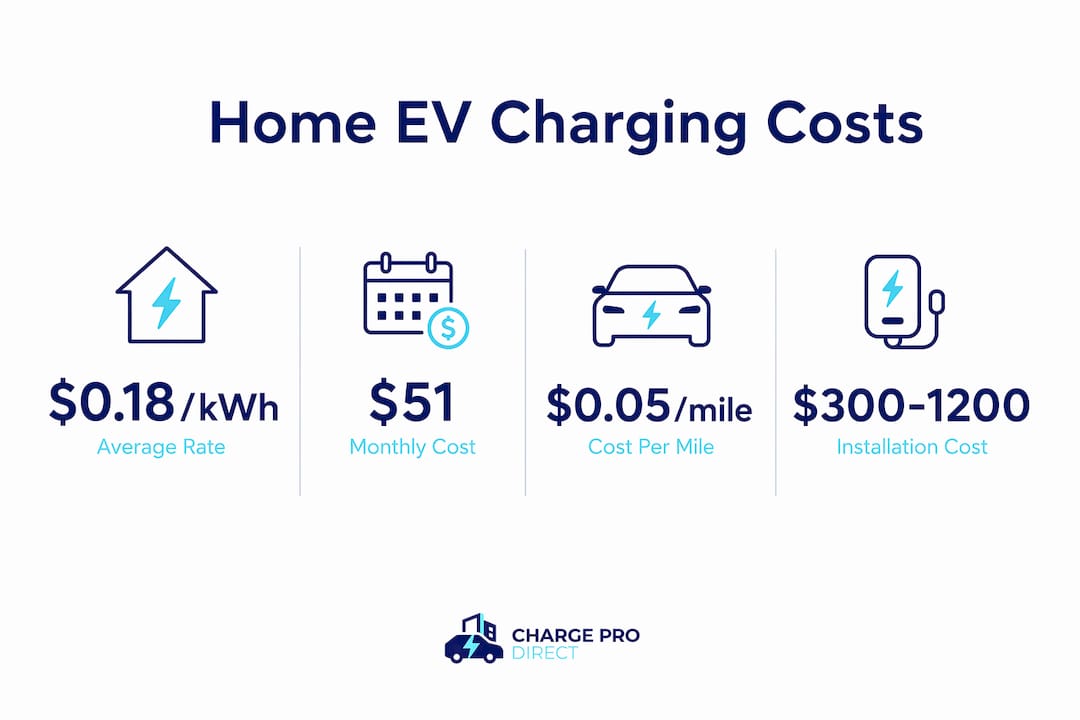
Charging an electric vehicle at home costs roughly a few cents per mile at the U.S. national average of about $0.18 per kWh. The formula is simple: divide your miles driven by your car’s efficiency (miles per kWh), then multiply by your local electricity rate. A driver covering 1,000 miles a month in a vehicle that gets 3.5 miles per kWh uses about 286 kWh, which costs roughly $51 at $0.18/kWh. Scale that up to a larger battery or higher mileage, and the math stays just as straightforward.
These numbers assume $0.18/kWh. Your actual rate may be higher or lower depending on your state and utility, which is exactly what the sections below unpack.

The math has four steps, and you only need two inputs: your monthly mileage and your car’s efficiency rating (found in the owner’s manual or on fueleconomy.gov).
Step-by-step:
Cost by battery size at $0.18/kWh:
| Battery size | kWh per full charge | Cost per full charge | Cost per mile (est.) |
|---|---|---|---|
| 40 kWh | 40 kWh | $7.20 | ~$0.05 |
| 60 kWh | 60 kWh | $10.80 | ~$0.05 |
| 75 kWh | 75 kWh | $13.50 | ~$0.06 |
| 100 kWh | 100 kWh | $18.00 | ~$0.06 |
Note: Real-world charging adds 10–15% for charging losses. Costs above reflect usable kWh, not wall-outlet draw.
Three worked examples:
Low-mileage driver (500 miles/month, 4 mi/kWh, $0.18/kWh): 500 ÷ 4 = 125 kWh. 125 × $0.18 = about twenty dollars per month, or a few cents per mile.
Average U.S. driver (over one thousand miles/month, 3.5 mi/kWh, $0.18/kWh): about fifty dollars a month. Kelley Blue Book’s sample calculation used a slightly higher April 2026 EIA rate and resulted in a monthly cost of about $65.30 for a 1,015-mile month, demonstrating how rate differences affect totals.
High-mileage commuter (around 1,500 miles/month, 3 mi/kWh, $0.18/kWh): roughly ninety dollars per month, or a few cents per mile. Public DC fast charging at higher rates costs substantially more for the same mileage.
Pro Tip: Run this calculation once with your actual utility rate, not the national average. Even a $0.03/kWh difference moves your monthly bill by $15 or more on a typical charging load.
Your local electricity rate is the single biggest variable in your monthly charging cost. The U.S. residential average sits around $0.18/kWh, but that number masks a wide spread. Louisiana homeowners often pay under $0.12/kWh, while California and Hawaii residents regularly see $0.25–$0.35/kWh or higher. That range means the same charging routine can cost twice as much depending on where you live.
Time-of-use (TOU) pricing is where EV owners can genuinely cut costs. Under TOU plans, utilities charge less during off-peak hours (typically late night to early morning) and more during peak demand windows (usually late afternoon and evening). Shifting your charging to off-peak hours can reduce your charging electricity costs significantly compared to charging at peak rates. On a typical monthly charging bill, that may translate into substantial savings.
National average rate: ~$0.18/kWh (EIA/AFDC). Off-peak TOU rates in many states drop to $0.10–$0.13/kWh, which can cut your monthly charging bill nearly in half.
Finding your utility’s TOU program takes about five minutes. Look at your monthly bill for a “rate schedule” or “rate code” line, then search your utility’s website for “time-of-use” or “EV rate.” Most utilities also list TOU options on their residential rate pages, and the DSIRE database tracks available programs by state.
Pro Tip: Before enrolling in a TOU plan, check whether your utility has a dedicated EV rate separate from a general TOU plan. EV-specific rates sometimes offer lower off-peak windows (midnight to 6 AM) that align better with overnight charging schedules.
Level 1 charging uses a standard 120V household outlet. No special equipment is needed beyond the cord that ships with your vehicle. It adds roughly 3–5 miles of range per hour, which works fine if you drive under 30 miles a day and park overnight. The cost: essentially $0 in hardware if you already have an accessible outlet.
Level 2 charging runs on a 240V circuit, the same voltage as a clothes dryer. A dedicated wall-mounted charger (EVSE) delivers 20–30+ miles of range per hour, fully charging most EVs in 4–8 hours overnight. Equipment costs range from about $200 to $900 depending on amperage and features, and professional installation is required.
For a deeper look at Level 1 vs. Level 2 hardware options, Chargeprodirect’s homeowner guide covers connector types, amperage choices, and what to look for before you buy.
| Cost component | Price range |
|---|---|
| Charger hardware (Level 2) | Several hundred dollars to near a thousand dollars |
| Electrician labor | Several hundred dollars up to about eight hundred dollars |
| Permits | Tens to a few hundred dollars |
| Conduit and wiring | Low to mid hundreds of dollars |
| Electrical panel upgrade | Approximately one to several thousand dollars |
| Total (no panel upgrade) | Low to mid thousands of dollars |
| Total (with panel upgrade) | Around two thousand to over five thousand dollars |
Sources: EnergySage, Destination Charged
Typical installations take one to four hours for a simple job and a full day or more when panel work is involved. Expect an electrician to do a brief on-site assessment before quoting, and be cautious of anyone who quotes a firm price without seeing your panel and parking location.
For a full breakdown of EV charger installation costs, including permit timelines and what to expect on installation day, Chargeprodirect’s 2026 homeowner guide walks through each scenario in detail.
Smart Level 2 chargers let you schedule charging to start automatically during off-peak hours, set power limits to protect your home’s electrical load, and monitor usage through an app. These features are not just conveniences. They are the mechanism that makes TOU savings automatic rather than something you have to remember every night.

Here is a concrete comparison. Say your peak rate is $0.28/kWh and your off-peak rate is $0.12/kWh. Charging a 75 kWh battery at peak costs $21.00. The same charge at off-peak costs $9.00. That $12 difference per charge, multiplied across 20 charges a month, adds up to $240 in monthly savings. Over five years, shifting to off-peak charging can save hundreds to over a thousand dollars for frequent chargers.
Solar adds another layer. If your panels generate surplus power during the day, you can use net metering credits to offset the cost of overnight EV charging. The math depends on your system size, your utility’s net metering policy, and how much you drive. A 7 kW solar array in a sunny climate can generate 25–35 kWh on a good day, enough to cover a typical overnight charge with credits to spare. The caveat: net metering rates vary by state and utility, and some utilities have moved to less favorable export rates in recent years.
Pro Tip: Set your charger’s scheduled start time to 30 minutes after your utility’s off-peak window opens, not right at midnight. Grid demand spikes at exactly midnight when thousands of scheduled chargers kick on simultaneously, and some utilities adjust their demand calculations accordingly. Starting at 12:30 AM costs nothing extra and avoids that brief demand spike.
Public charging is a convenience tool, not a cost-effective daily strategy. The numbers make that clear.
| Charging type | Typical cost per kWh | Cost for 75 kWh charge |
|---|---|---|
| Home (residential average) | ~$0.18 | ~$13.50 |
| Public Level 2 | ~$0.25 | ~$18.75 |
| Public DC fast charging | ~$0.53 | ~$39.75 |
Source: Qmerit cost analysis
Public DC fast charging commonly runs about three times the cost of home charging on a per-kWh basis. The reasons are straightforward: public networks pay for real estate, equipment maintenance, demand charges from utilities, and network operating fees. Those costs get passed to the driver.
When home charging makes sense:
When public charging is worth it:
Up to 80–90% of EV charging happens at home for owners who have that option. Public fast charging fills the gaps, but your home charger is where the real cost savings live.
Not every EV owner needs to spend $1,500 on a Level 2 installation. Here is how to figure out where you stand.
Decision checklist:
Questions to ask your electrician before signing anything:
Understanding your panel capacity before you start shopping for hardware can save you from buying a 48A charger your panel cannot support.
Red flags to watch for:
Unpermitted electrical work can create insurance and resale liabilities. Always confirm who pulls the permit before work begins, and get that answer in writing.
Home EV charging costs roughly a few cents per mile at the U.S. national average rate of $0.18/kWh, and a professionally installed Level 2 charger typically costs several thousand dollars before any rebates or panel upgrades.
| Point | Details |
|---|---|
| Cost per mile at home | Home charging runs $0.05–$0.06 per mile at the $0.18/kWh national average rate. |
| TOU savings potential | Shifting to off-peak charging can cut your charging electricity cost by 30–50%. |
| Installation cost range | A professionally installed Level 2 charger typically costs $1,200–$3,000; complex jobs with panel upgrades can reach $5,000+. |
| Public charging premium | Public DC fast charging runs about three times the cost of home charging per kWh (~$0.53 vs. ~$0.18). |
| Chargeprodirect guidance | Chargeprodirect offers product guidance, an EV Charging Savings Calculator, and curated Level 2 charger options to help you plan your home setup. |
There is a number most EV shoppers focus on that is actually the wrong number: the public charging network coverage in their area. We understand the instinct. Range anxiety is real, and a dense fast-charging network feels like insurance. But once you own an EV and charge at home regularly, you realize that public fast charging is the exception, not the routine.
The genuine financial case for home charging is not just the per-kWh savings, though those are real and significant. It is the predictability. You know what your utility charges. You can schedule around TOU windows. You wake up every morning with a full battery without stopping anywhere. That convenience has a dollar value that most cost comparisons never capture.
What homeowners consistently underestimate is the electrical assessment step. Most people pick their charger first, then call an electrician. That is backwards. Your panel’s available capacity and the distance from the panel to your parking spot determine whether your installation costs $1,200 or $4,000. Getting a home energy audit before you buy hardware is not extra work. It is the step that keeps you from buying the wrong charger for your home’s actual electrical situation.
Long-term, homeowners who install Level 2 chargers and enroll in TOU programs tend to see the installation pay for itself within two to four years through reduced public charging costs and lower per-kWh rates. Add available utility rebates, and the upfront cost shrinks further. Check your state’s current incentives through DSIRE.
Picking a Level 2 charger without knowing your panel capacity, your car’s onboard charger limit, or your utility’s TOU enrollment process is how homeowners end up with hardware that underperforms or requires expensive rewiring. Chargeprodirect’s guides and Savings Calculator help you plan before you buy. Charger installation provided by Treehouse.
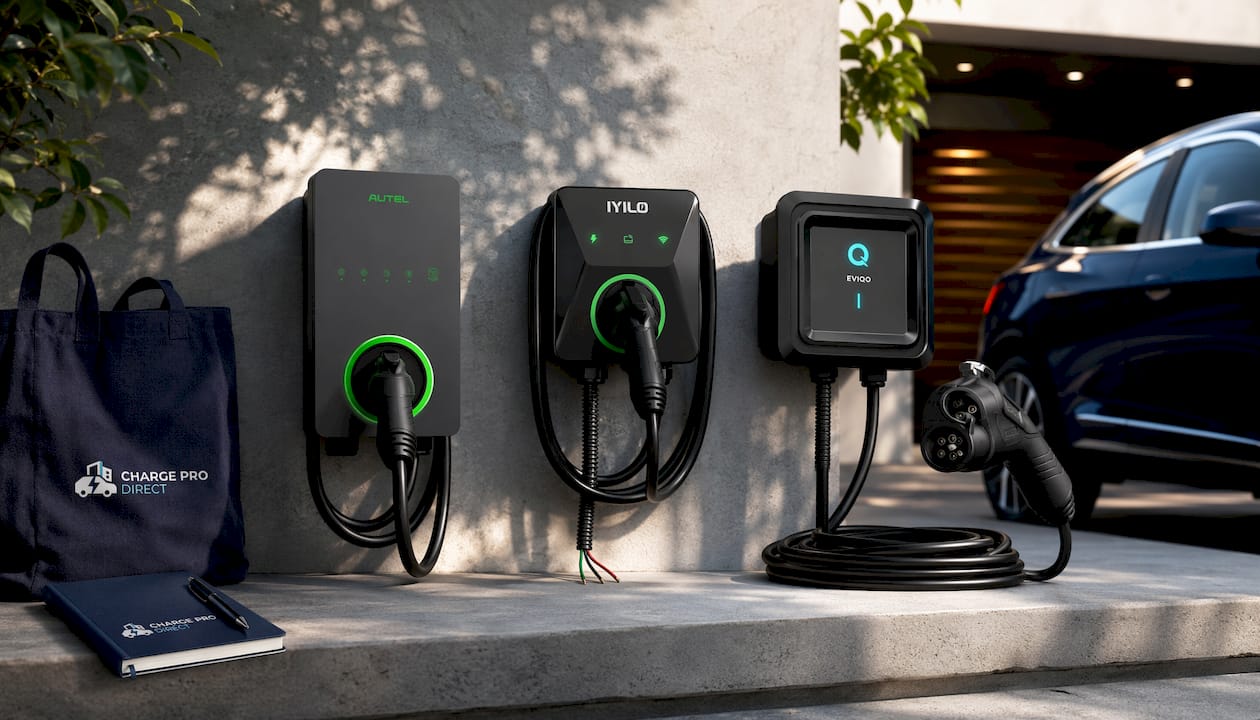
Three chargers worth reviewing for a 2026 home installation:
Use the EV Charging Savings Calculator to plug in your mileage, your utility rate, and your current gas spending to see your personalized payback estimate. Local installation costs vary, so getting three quotes from licensed electricians is always the right move before committing to a specific setup.
Electricity rates and incentive programs change regularly. Use these primary sources to verify current figures for your location:
Rates shift with seasonal demand and utility rate cases. Check your utility’s current rate schedule directly, not a cached third-party page, when running your own calculations.
At the U.S. average rate of about $0.18/kWh, a typical driver covering 1,000 miles per month adds roughly $51 to their monthly electric bill. Your actual increase depends on your local rate, your vehicle’s efficiency, and how many miles you drive.
Most EV manufacturers recommend charging to 80% rather than 100% for daily use, because lithium-ion batteries degrade more slowly when kept below full capacity. Charging to 100% is fine occasionally, such as before a long trip, but 80% is the standard daily target for battery longevity.
Home charging is significantly cheaper than public charging and usually cheaper than fueling a comparable gas vehicle. At $0.18/kWh, home charging costs roughly $0.05–$0.06 per mile. Gas car costs vary depending on fuel prices and efficiency.
Public DC fast charging typically runs around $0.53/kWh, versus roughly $0.18/kWh at home. That makes public fast charging about three times more expensive per kWh, which adds up to a meaningful cost difference for drivers who rely on it regularly.
Search DSIRE for state-level rebates and utility incentive programs that may apply in your area, and check your utility’s website for EV charger rebates.