
Need Installation?
Book a licensed install
Book a licensed EV charger install

The J1772 charger is defined as the North American standard connector for Level 1 and Level 2 AC electric vehicle charging, governed by SAE International and required under NEC Article 625. Every major non-Tesla EV sold in North America uses this 5-pin connector to receive AC power safely. Understanding how it works, what it costs to install, and how it fits alongside emerging standards like NACS gives you a real advantage before you spend a dollar on equipment.
The J1772 standard defines a 5-pin connector that supports 1.44 kW to 19.2 kW of single-phase AC charging. That range covers everything from a basic overnight top-up to a full charge in a few hours. The standard is maintained by SAE International and has been the foundational North American AC charging protocol since its widespread adoption.
The five pins each serve a specific role. Two carry line voltage (L1 and Neutral), one is the protective earth ground (PE), one is the Control Pilot (CP), and one is the Proximity Pilot (PP). The Control Pilot pin is the most important. It uses pulse-width modulation (PWM) to communicate between the charger and the vehicle, confirming the connection is secure before power flows. This handshake prevents accidental energizing of the cable.
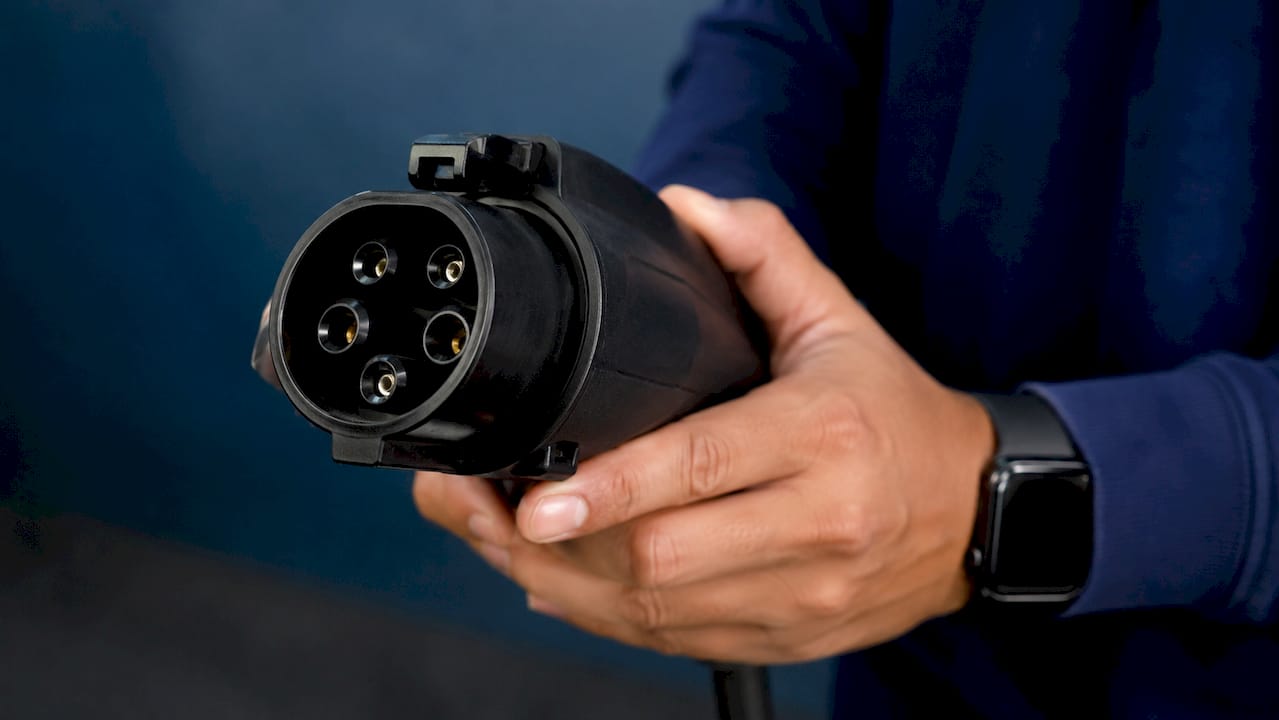
The connector also includes a mechanical latch that locks it into the vehicle’s charge port during a session. The latch releases only when the driver presses the button on the handle. This prevents accidental disconnection during charging, which could damage both the vehicle and the equipment.
| Charging Level | Voltage | Typical Amperage | Power Output | Miles Added per Hour |
|---|---|---|---|---|
| Level 1 | 120V AC | 12A-16A | 1.44-1.92 kW | 3-5 miles |
| Level 2 | 240V AC | 16A-80A | 3.84-19.2 kW | 25-40 miles |
Pro Tip: Level 2 at 240V uses the same voltage as your clothes dryer. If your home already has a dryer circuit nearby, your electrician may be able to tap into that infrastructure to reduce installation costs.
Installing a Level 2 EV charger at home requires a dedicated circuit sized correctly for continuous load. NEC Article 625 mandates that the circuit be rated at 125% of the charger’s continuous draw. A 40A charger, for example, requires a 50A dedicated circuit breaker. That rule exists because EV charging runs for hours at a time, which qualifies as a continuous load under the electrical code.
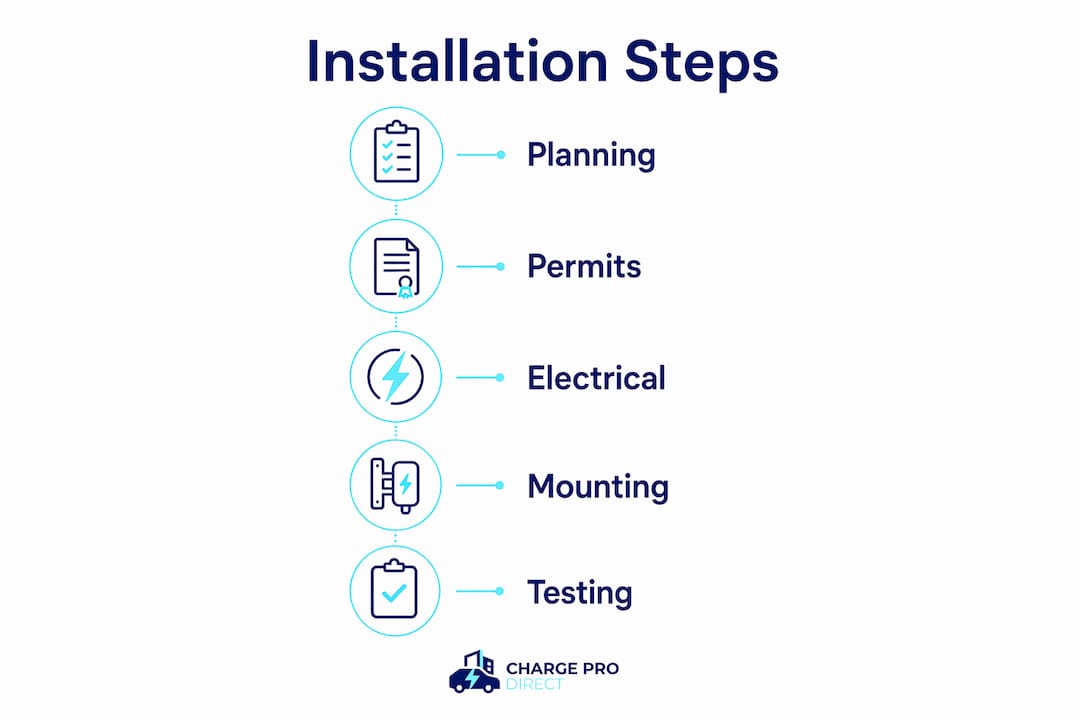
Here is what a proper installation involves:
A typical home installation takes 2-4 hours and costs $500-$1,500 including the charger and labor. That range depends on panel distance, local labor rates, and whether a panel upgrade is needed.
Professional installation is not optional. Licensed electricians perform load calculations, pull permits, and ensure code compliance. Improper wiring under continuous high load is a documented fire risk. Your homeowner’s insurance may also deny claims related to EV charging if the installation was done without permits.
Pro Tip: If your panel is full or undersized, ask your electrician about a smart load-shedding device before committing to a panel upgrade. A load-sharing device can share an existing dryer circuit with your EV charger, costing $400-$500 instead of a full panel upgrade at $1,500-$4,000.
The J1772 plug type is standard on virtually every non-Tesla EV sold in North America. Vehicles from Ford, GM, Hyundai, Kia, Honda, Nissan, Volkswagen, BMW, Mercedes-Benz, and Rivian all use J1772 for AC charging. This broad adoption means a J1772 charging station works across brands without adapters for the vast majority of current EVs.
Key compatibility facts to know:
Pro Tip: Check your vehicle’s onboard charger capacity before buying a high-amperage unit. A charger’s amperage above your vehicle’s limit delivers no additional speed and costs more for no benefit.
Selecting the right J1772 charger comes down to three factors: your vehicle’s onboard charger capacity, your electrical panel’s available capacity, and your daily driving habits. Matching charger amperage to your actual needs avoids overspending on capacity you cannot use.
Practical guidance for buyers:
A smart load-shedder is worth serious consideration if your panel is near capacity. It shares an existing high-amperage circuit between your EV charger and another appliance, automatically prioritizing the EV when the other appliance is idle. This avoids a $1,500-$4,000 panel upgrade in many cases.
The J1772 standard is not disappearing. Millions of vehicles on North American roads use J1772 ports, and that installed base will remain relevant for at least a decade. The rise of NACS changes the connector landscape for new vehicles, but it does not make existing J1772 infrastructure obsolete.
| Feature | J1772 | NACS |
|---|---|---|
| AC charging | Yes (Level 1 and Level 2) | Yes |
| DC fast charging | Via CCS1 extension | Yes (integrated) |
| Current vehicle base | Millions of non-Tesla EVs | New Ford, GM, Rivian, and others |
| Adapter availability | J1772-to-NACS adapters available | NACS-to-J1772 adapters available |
| Infrastructure footprint | Extensive across North America | Growing rapidly |
Universal adapters are the practical solution for households with mixed fleets or plans to switch vehicles. Many current chargers ship with or support adapters for both J1772 and NACS vehicles. Buying a charger with adapter support today protects your investment as the market shifts.
The J1772 connector’s role in AC charging remains secure. NACS adoption primarily affects DC fast charging convenience and new vehicle port design. For home and workplace Level 2 charging, J1772 infrastructure continues to serve the majority of the EV market effectively.
The J1772 charger is the definitive North American AC charging standard, and selecting the right unit requires matching your vehicle’s onboard charger capacity, your panel’s available amperage, and your daily driving needs.
| Point | Details |
|---|---|
| J1772 is the AC standard | It supports Level 1 and Level 2 charging from 1.44 kW to 19.2 kW across North America. |
| NEC 625 governs installation | Circuits must be sized at 125% of continuous load; a 40A charger needs a 50A breaker. |
| Vehicle onboard charger sets the limit | Buying a higher-amperage EVSE than your vehicle supports wastes money with no speed gain. |
| Industrial outlets are non-negotiable | Plug-in chargers require rated NEMA 14-50 receptacles to prevent overheating and fire. |
| J1772 remains relevant alongside NACS | Adapters bridge the gap; J1772 infrastructure serves millions of vehicles for years ahead. |
The most common mistake is fixating on maximum amperage. Buyers see a 48A charger and assume more is better. In reality, the vehicle’s onboard charger sets the ceiling, and most daily drivers never need more than a 32A or 40A unit.
The second mistake is skipping the panel assessment. Buy a 48A charger first, and you may discover the panel has no room for a 60A breaker without a costly upgrade. A short conversation with a licensed electrician before purchasing avoids that.
The practical order: check the vehicle’s onboard charger spec first, then have an electrician assess the panel before buying anything. If the panel is tight, ask about load-shedding devices before committing to an upgrade. And if your next car may use NACS, factor that in now. Adapters work, and many chargers come in both J1772 and NACS versions.
The J1772 standard is not going away. It is the backbone of North American EV charging infrastructure, and a well-chosen, properly installed unit will serve you reliably for years.
Choosing the right Level 2 charger is straightforward when you have the right options in front of you. Chargeprodirect carries J1772 Level 2 chargers in hardwired and plug-in configurations at 40A and 48A.
J1772 chargers matched to your circuit
Pick the one that fits the circuit you have or plan to install.
Not sure which fits your car and panel? Try the EV Charger Finder. Residential EV chargers ship free, and Shop Pay Installments is available at checkout.
J1772 refers to the SAE standard that defines the 5-pin AC charging connector used across North America for Level 1 and Level 2 electric vehicle charging. It governs the physical connector design, voltage, amperage, and the Control Pilot communication protocol between the charger and vehicle.
Tesla vehicles with NACS ports require a NACS-to-J1772 adapter to use a J1772 charging station. Most Tesla owners can purchase this adapter directly from Tesla or through third-party suppliers.
A professional installation typically takes 2-4 hours. Total costs, including the charger and labor, generally range from $500 to $1,500 depending on panel distance, local permit fees, and whether any electrical upgrades are needed.
Yes. NEC Article 625 requires a dedicated circuit sized at 125% of the charger’s continuous load. A 40A charger requires a 50A dedicated breaker and appropriately rated wiring.
No. Your vehicle’s onboard charger sets the maximum AC charging rate. A 48A EVSE delivers no additional speed to a vehicle with a 32A onboard charger limit. Always check your vehicle’s specifications before selecting charger amperage.

