
Need Installation?
Book a licensed install
Book a licensed EV charger install

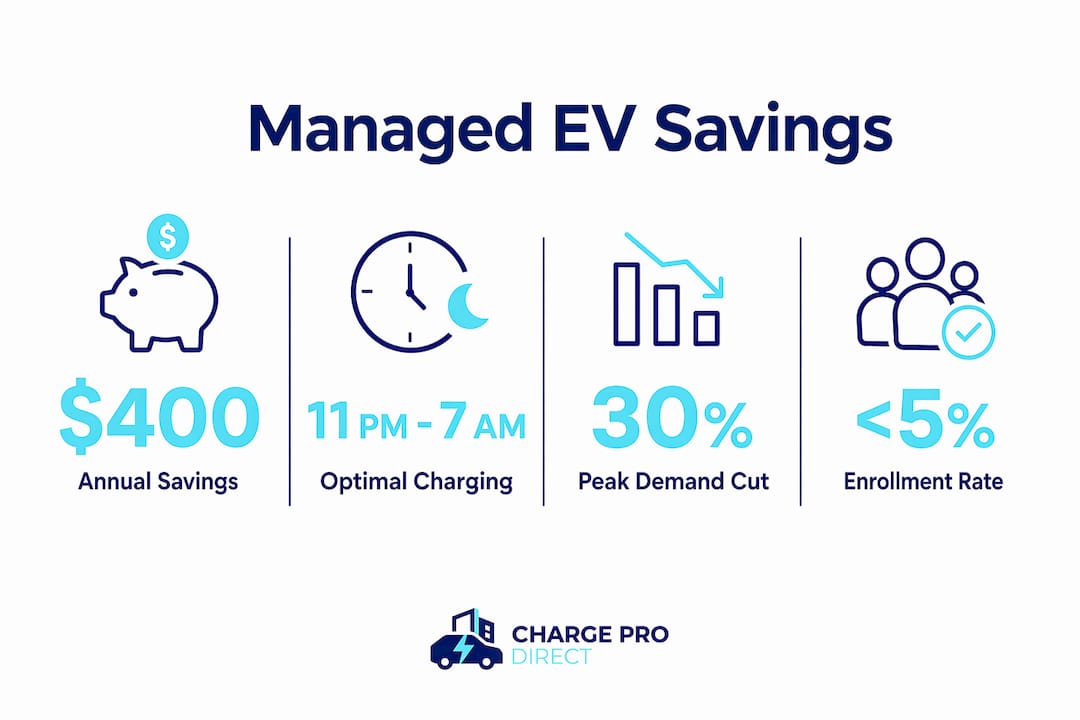
Managed EV charging is the strategic control of when and how electric vehicles charge, with the goal of cutting costs and protecting grid stability. The industry term for this practice is “electric vehicle charging management,” and it covers everything from simple overnight scheduling to automated demand response programs. Active managed charging can reduce system costs by up to $400 per EV annually and cut charging peaks by up to 50%. That kind of impact makes it one of the most practical tools available to homeowners, businesses, and property managers who want lower energy bills without sacrificing convenience.
Managed EV charging works by shifting the bulk of charging activity to off-peak hours, typically late at night when electricity rates are lowest and grid demand is minimal. Software platforms communicate with chargers using open protocols like OCPP (Open Charge Point Protocol) to schedule, pause, or throttle charging sessions automatically. The result is that 95% of charging shifts to off-peak hours, which can double a distribution grid’s EV hosting capacity and defer costly infrastructure upgrades by up to 10 years.
The difference between unmanaged and managed charging is significant in practice. An unmanaged charger draws full power the moment a driver plugs in, often during peak evening hours when the grid is already stressed. A managed system, by contrast, accepts the plug-in but delays or reduces the charge rate until conditions are favorable.

| Factor | Unmanaged charging | Managed charging |
|---|---|---|
| Charging time | Immediate, any hour | Scheduled to off-peak windows |
| Peak grid impact | High | Reduced by up to 50% |
| Annual cost per EV | Higher | Up to $400 less |
| Grid hosting capacity | Limited | Potentially doubled |
| Upgrade deferrals | None | Up to 10 years |
In a residential setting, managed charging might mean your Level 2 home charger starts at 11:00 PM and finishes before your morning commute. In a commercial parking garage, it means a software platform balances load across 20 stations so the building never trips a demand charge threshold.
Pro Tip: If your utility offers a time-of-use rate plan, pairing it with a managed charger can cut your monthly charging cost significantly without any change to your daily routine.
Participation rates in managed charging programs are strikingly low, even when utilities offer financial incentives. Voluntary enrollment sits at just 4.6% even when utilities offer $40 incentives to join. Without any incentive, enrollment drops to roughly 1%. That gap between the technology’s potential and actual uptake is the central problem facing electric vehicle charging management today.
Several barriers explain why drivers hesitate to sign up:
Shifting from opt-in to opt-out or default enrollment models is likely the most effective path to meaningful participation in managed EV charging programs. When customers must actively choose to leave rather than actively choose to join, participation rates rise substantially.
The regulatory infrastructure to support that shift is not yet in place in most states. Utilities lack the data on home charger installations needed to automatically enroll new EV owners. Until regulators require installers or automakers to notify utilities at the point of charger installation, opt-out models will remain difficult to execute at scale.
Multifamily properties and commercial buildings face a more complex version of the same challenge. You are not managing one charger for one driver. You are managing dozens of chargers for residents or customers with different schedules, different vehicles, and different expectations. EV charging is a systems problem, and poor planning creates operational headaches and unexpected costs that undermine the entire investment.
A practical implementation plan for businesses and property managers follows this sequence:
Most EV charging projects fail not because of bad hardware choices but because of ignored system-level planning. The electrical panel, the parking layout, the billing workflow, and the software platform must all work together from day one.
Pro Tip: Use a commercial EV assessment tool before finalizing your charger count. Knowing your actual load capacity prevents costly panel upgrades after installation.
EV charging management software is the brain of any managed charging network. Without it, even the best hardware operates as a simple dumb outlet. With it, you get automated load balancing, real-time monitoring, remote diagnostics, and detailed billing reports from a single dashboard.
Enterprise-grade platforms built on open standards offer the following capabilities:
| Software feature | Benefit to operator | Benefit to driver |
|---|---|---|
| Load balancing | Prevents panel overloads | Consistent charge speed |
| Demand charge control | Lowers monthly utility bills | No impact on session |
| Remote diagnostics | Faster fault resolution | Less downtime |
| OCPP/OCPI compliance | Vendor flexibility | Network roaming access |
| Billing automation | Accurate cost recovery | Clear receipts |
Interoperability standards like OCPP and OCPI are not optional features. They are the foundation of a scalable, flexible charging ecosystem. Without them, operators get locked into a single vendor’s ecosystem and lose the ability to upgrade hardware or software independently.
The most significant near-term shift will be the move from voluntary to default enrollment in managed charging programs. Demand charges and capacity-based pricing create a financial steering effect that nudges drivers toward off-peak charging even without a formal program. Regulators in several states are already exploring pricing reforms that complement managed charging by making peak-hour charging noticeably more expensive.
Data sharing remains the biggest technical barrier to scaling managed charging networks. Utilities need real-time data from chargers to manage grid load effectively, but that data currently sits in siloed proprietary systems.
Without consistent data-sharing standards across charger manufacturers and software platforms, utilities cannot effectively manage EV load at the grid level. The result is a fragmented system where the technology exists but the coordination does not.
Vehicle-to-grid technology adds another layer of complexity and opportunity. When EVs can return power to the grid, they become mobile storage assets. That changes the economics of managed charging entirely, turning a cost-management tool into a potential revenue source for EV owners. The regulatory and technical groundwork for V2G is being laid now, and the EV charging infrastructure decisions you make today will determine whether you can participate in those programs tomorrow.
Managed EV charging delivers the greatest value when software, hardware, and system planning work together from the start, not as afterthoughts added to an existing installation.
| Point | Details |
|---|---|
| Cost reduction potential | Active managed charging cuts system costs by up to $400 per EV annually and reduces peak loads by 50%. |
| Participation gap | Voluntary enrollment reaches only 4.6% even with incentives; opt-out models are the practical solution. |
| System planning is non-negotiable | Electrical capacity, parking design, and billing must be planned together before hardware is purchased. |
| Software drives scalability | OCPP and OCPI-compliant platforms prevent vendor lock-in and enable load balancing, billing, and roaming. |
| Future-proof your investment | Choosing open-protocol hardware today positions you to participate in V2G and grid programs as they mature. |
Many businesses and property managers install chargers and then scramble to fix the aftermath, and the pattern is clear: the hardware gets too much attention and the system gets almost none. Operators spend weeks comparing charger brands and almost no time asking whether their electrical panel can handle the load or whether their billing software can talk to their charger.
The research backs this up. The main reason EV charging projects fail is not bad hardware. It is ignored system-level planning. That is a solvable problem, but only if you treat the charger as one component in a larger system rather than the whole solution.
Our other strong view: the industry’s reliance on voluntary opt-in programs is a dead end. A 4.6% participation rate is not a program. It is a pilot that never scaled. Regulators need to move toward default enrollment, and utilities need the data infrastructure to make that possible. Until that happens, the grid benefits of managed charging will remain theoretical for most communities.
For anyone buying chargers today, our practical advice is simple. Choose hardware that supports OCPP. Choose a software platform that is hardware-agnostic. Plan your electrical capacity before you finalize your charger count. And if you are a property manager, decide on your billing model before you buy anything else. Getting those four things right puts you ahead of most installations already in the ground.
Finding the right hardware for a managed charging setup does not have to be complicated. Chargeprodirect carries Level 2 chargers built for both home and commercial use, with options that support the open protocols and amperage ranges that managed charging networks require.

The EVIQO 48A hardwired Level 2 charger is a strong choice for permanent installations where maximum charge speed and network compatibility matter. For plug-in flexibility, the EVIQO 48A NEMA 14-50 model works across a wide range of managed charging setups. On a NEMA 14-50 outlet, set it to 40A. The full 48A requires hardwiring on a 60A circuit. Not sure which charger fits your situation? Use the EV charger finder for homes or the commercial charger finder for business properties. Residential EV chargers ship free.
Managed EV charging is the automated control of when and at what power level an electric vehicle charges, typically to reduce costs and grid stress. It uses software platforms and protocols like OCPP to schedule charging during off-peak hours.
Active managed charging can reduce system costs by up to $400 per EV annually, according to research from the Brattle Group. It also cuts charging peaks by up to 50% and can defer grid upgrade costs by a decade.
Voluntary enrollment reaches only 4.6% even with $40 incentives, largely because drivers distrust utility control and are unaware programs exist. Shifting to opt-out enrollment models is the most effective way to increase participation.
OCPP (Open Charge Point Protocol) is the open communication standard that lets charging hardware talk to any compatible software platform. Chargers that support OCPP give operators the freedom to switch software vendors without replacing hardware.
Yes, but only when electrical capacity, parking layout, and billing are planned together before installation. Multifamily EV charging projects that skip system-level planning consistently face higher costs and operational problems after launch.