
Need Installation?
Book a licensed install
Book a licensed EV charger install

For daily cycling and safety, LiFePO4 wins. For range and weight, NMC still leads. If you’re powering a home, a boat, or a solar bank you use every day, LiFePO4 gives you a longer service life and a much wider thermal safety margin, if you need to squeeze the most range out of the smallest, lightest pack, like in an EV or a portable rig you carry by hand, NMC’s higher energy density still makes sense. Many home backup catalogs focus on LiFePO4 for exactly this reason.
TL;DR:
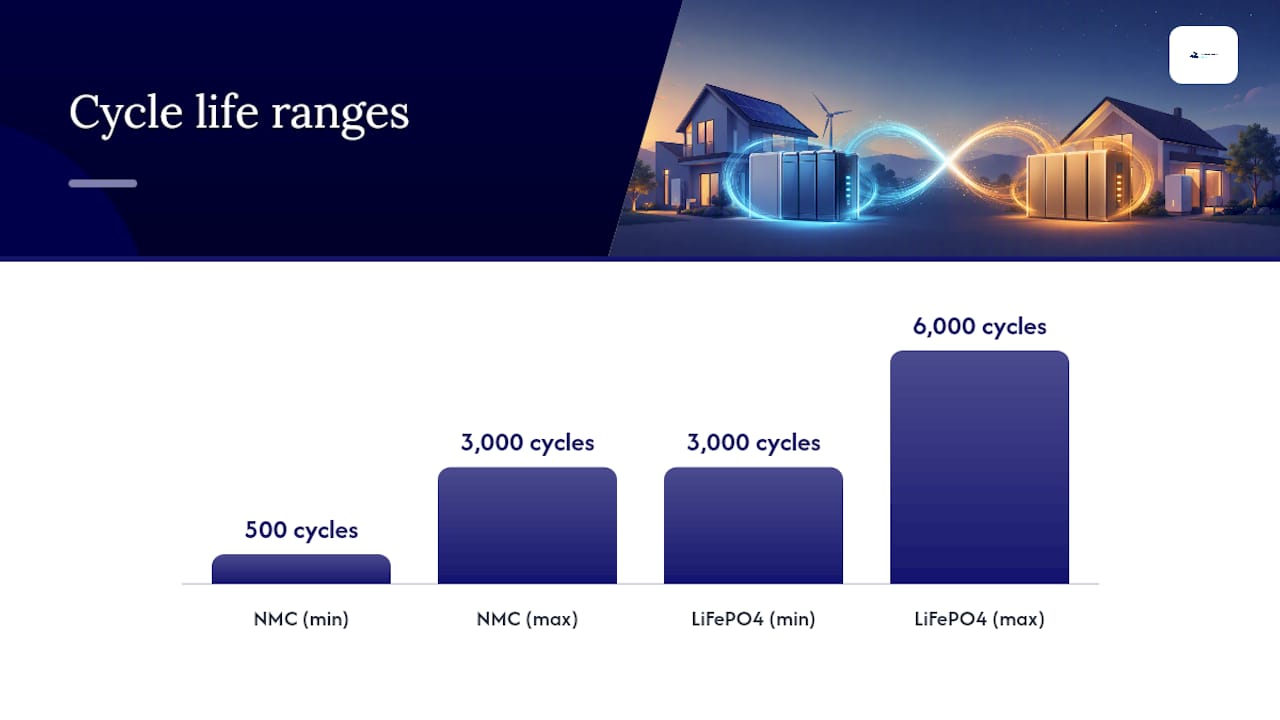
- LiFePO4 batteries last significantly longer, with 3,000 to 6,000 or more cycles, compared to NMC’s 500 to 3,000 cycles, making them ideal for frequent cycling systems.
- NMC batteries provide higher energy density, up to 250 Wh/kg, enabling lighter and more compact designs for applications like EVs and portable power stations.
- The wider thermal stability of LiFePO4, with decomposition onset around 270°C to 310°C, offers a much larger safety margin than NMC, which starts decomposing at 150°C to 210°C.
- For stationary and home use, the long cycle life and stability of LiFePO4 reduce total lifetime costs, especially when cycling often, whereas NMC’s density advantages benefit weight-constrained mobile setups.
- Cold-weather charging presents risks for both chemistries, but NMC tolerates low temperatures slightly better, though both require careful management to avoid capacity loss below freezing.
Every buying decision here comes down to five factors, and no chemistry wins all five. You’re trading energy density for lifespan, and raw power output for thermal margin.
Here’s how the two chemistries stack up on the metrics that matter most:
The thermal gap is the number that surprises most first-time buyers. A difference of over 100 degrees Celsius in decomposition onset isn’t a minor engineering footnote. It’s the reason LiFePO4 dominates home energy storage, where a battery sits indoors or in a garage for a decade or more, while NMC still rules categories where every gram and every cubic inch counts.
If you’re weighing this decision for a stationary system, energy density matters far less than most buyers assume. What actually matters is delivered kilowatt-hours over the life of the warranty, and that number tilts hard toward LiFePO4 for anything you plan to cycle often.
LiFePO4 uses an olivine crystal structure, where iron, phosphate, and oxygen atoms lock together through a strong phosphorus-oxygen bond. NMC uses a layered oxide structure built from nickel, manganese, and cobalt. That structural difference is the entire reason these two chemistries behave so differently under stress.
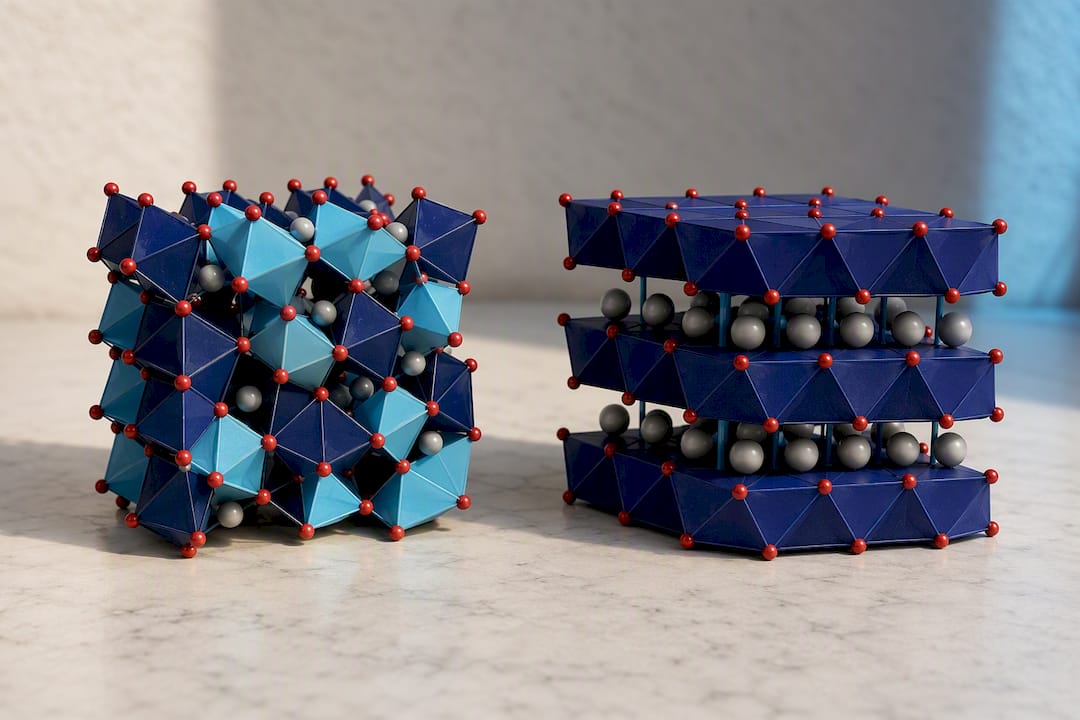
The phosphate bond in LiFePO4 is chemically stable at high temperatures, which is why it doesn’t release oxygen easily even when pushed hard. NMC’s layered structure is more prone to breaking down and releasing oxygen as heat builds, and that released oxygen is what feeds a runaway fire once it starts. This is the mechanical reason DSC testing consistently shows LiFePO4 decomposing at 270°C to 310°C while NMC breaks down at 150°C to 210°C.
That gap has real consequences for where you can safely install each chemistry:
Pro Tip: Chemistry sets the ceiling on safety, but pack engineering decides whether you actually hit that ceiling. A well-built NMC pack with a strong battery management system can outperform a cheaply made LiFePO4 pack, so don’t assume chemistry alone guarantees safety.
Numbers on a spec sheet only matter once you translate them into how a battery actually behaves in your garage, your RV, or your car. Here’s what the raw figures mean for weight, usable capacity, and how many years you can expect before replacement.
NMC’s density advantage, 150 to 250 Wh/kg against LiFePO4’s 90 to 160 Wh/kg, shows up most in weight-sensitive builds. An EV pack or a backpack-sized power station benefits directly from every gram saved. In a stationary cabinet bolted to a garage wall, that weight advantage barely registers.
Cycle life tells a different story. A LiFePO4 pack cycled once a day can realistically run for 8 to 16 years before dropping to 80% capacity, based on the 3,000 to 6,000-plus cycle range NREL documents. An NMC pack under the same daily cycling might need replacement in 2 to 8 years, depending on the formulation.
Charge rates matter too. Most LiFePO4 and NMC cells handle similar C-rates for everyday charging, but LiFePO4 has a hard rule that NMC doesn’t share: charging below freezing risks lithium plating, which permanently eats into capacity. NMC tolerates cold charging a bit more gracefully, though performance still drops.
| Metric | LiFePO4 | NMC |
|---|---|---|
| Energy density | 90 to 160 Wh/kg | 150 to 250 Wh/kg |
| Cycle life (to 80%) | 3,000 to 6,000+ | 500 to 3,000 |
| Thermal onset | 270°C to 310°C | 150°C to 210°C |
| Cold charging | Risky below freezing without heating | More tolerant, still degraded |
| Best fit | Stationary, daily cycling | Weight and range critical |
The right chemistry depends entirely on what job the battery has to do, not on which one sounds more advanced. Home solar, backup power, and anything cycled daily favors LiFePO4 almost every time. The math is straightforward: a battery that lasts three times as many cycles at a similar or even lower cost per cycle wins the long game, even if it’s bulkier.
NMC still earns its place where mass and volume are the limiting factor. Portable power stations you carry by hand, EVs chasing maximum range, and occasional-use backup systems that rarely deep-cycle can lean on NMC’s density without paying much of a lifespan penalty, since they’re not putting thousands of cycles on the pack anyway.
Marine and RV applications sit in the middle. Space is tight, but vibration, humidity, and temperature swings are constant, which usually pushes the decision back toward LiFePO4’s durability.
Before you buy, run through this quick checklist:
The sticker price only tells half the story. What matters is cost per delivered kilowatt-hour across the battery’s entire life, sometimes called the levelized cost of storage.
Here’s the simplified math: divide the pack’s price by its usable capacity and its total cycle count, and you get a rough cost per cycle. DOE comparative analyses show that large-format LiFePO4 systems often produce a lower levelized cost of storage than NMC once you factor in frequent deep cycling, even though the upfront price per kilowatt-hour is often higher for LiFePO4.
The chemistry you pick only performs as advertised if the surrounding system is built for it. LiFePO4’s nearly flat voltage curve makes it hard for a basic battery management system to estimate state of charge accurately, so look for coulomb-counting BMS logic or a system that periodically recalibrates with a full charge. NMC needs tighter voltage and temperature control instead, since its narrower safety margins leave less room for error.
Cold climates need extra planning for either chemistry, but especially LiFePO4. Look for built-in heaters, insulated enclosures, or low-temperature charge cutoffs, particularly if the system will sit outdoors.
Pro Tip: If you’re in a cold climate, ask specifically about low-temperature charge cutoffs before you buy. A missing cutoff is one of the most common reasons LiFePO4 packs lose capacity faster than advertised. For installation and permitting specifics, guides like this California solar battery storage overview walk through what installers typically check.
Choosing between these two chemistries gets easier when you start from your actual power needs, not just a spec sheet. Our Build Your System guide helps you match battery capacity, chemistry, and cabinet configuration to your real household or business load instead of guessing.
For home and commercial stationary storage, LiFePO4 shows up repeatedly in the catalog for good reason. The LG 16H Prime Battery offers 16kWh at 400V, suited to whole-home backup setups that need serious capacity without daily degradation worries. For anyone assembling a modular system, the Ruixu 6 Slot Battery Cabinet comes pre-assembled with wheels and a busbar already built in, which simplifies installing multiple LFP modules into one enclosure.
If you’re still narrowing down capacity needs, reviewing your household loads before purchase can help avoid common pre-installation mistakes.
LiFePO4 has taken over stationary storage and mass-market EVs faster than most forecasts expected, and IEA deployment data backs that trend. NMC hasn’t disappeared. It still leads wherever range or portability outweighs lifespan.
Our advice: buy for your current duty cycle, not for a hypothetical future upgrade. A LiFePO4 system sized right for today’s daily solar cycling will outlast most homes’ actual energy needs, and chasing NMC’s density for a stationary application usually buys you nothing but a shorter-lived battery.
Comparing spec sheets only gets you so far. Estimating your usage before purchase helps avoid getting a battery too small for your winter loads or too large for your budget.
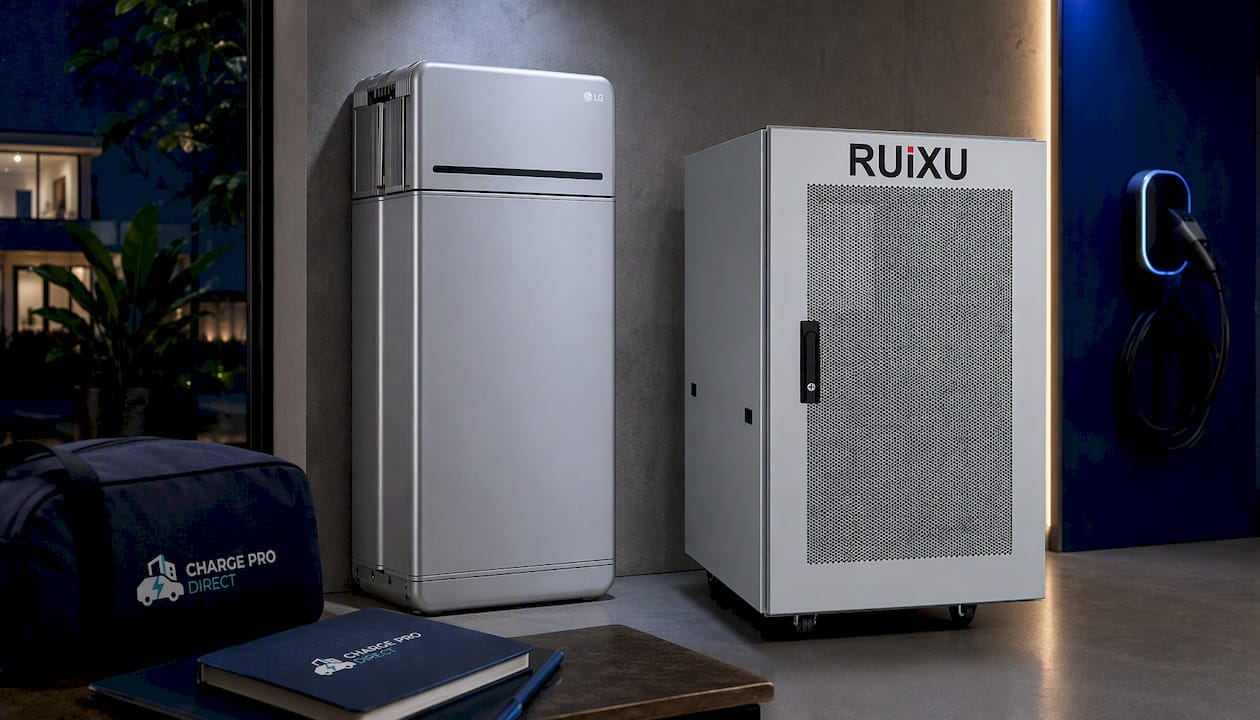
If home backup or solar storage is the goal, start with the home battery backup collection to see what capacity ranges fit typical households, or go straight to a specific system like the LG 16H Prime Battery if you already know you need serious whole-home capacity. Not sure yet how big your system should be? Reviewing a year of utility bills can help you understand your actual usage before purchasing, so you buy once and buy right.
LiFePO4 is safer in nearly every real-world comparison because its cathode structure resists thermal decomposition until far higher temperatures, roughly 270°C to 310°C versus 150°C to 210°C for NMC. Neither chemistry is completely immune to failure under severe mechanical damage or abuse.
Tesla has used both chemistries across its lineup, with NMC (and NCA variants) common in higher-range models and LiFePO4 increasingly used in standard-range vehicles built for cost efficiency and longevity.
LiFePO4 packs weigh more per kilowatt-hour than NMC because of lower energy density, and they need careful cold-weather charge management since charging below freezing risks permanent capacity loss from lithium plating.
NMC batteries have a shorter cycle life, typically 500 to 3,000 cycles versus LiFePO4’s 3,000 to 6,000-plus, and their lower thermal decomposition onset makes them more prone to severe thermal runaway if damaged or overcharged.