
Need Installation?
Book a licensed install
Book a licensed EV charger install

Solar battery storage is the technology that captures excess solar energy your panels produce and holds it for use when the sun isn’t shining, making solar power genuinely reliable for your home. Without storage, your panels send unused electricity back to the grid, often at rates far below what you pay to buy it back later. That gap is exactly why solar battery storage matters. The U.S. Department of Energy and platforms like EnergySage both confirm that pairing batteries with solar panels is the most effective way to increase energy independence, cut costs, and build real resilience against outages.
Solar panels generate the most electricity between 10 a.m. and 2 p.m. Your household demand peaks in the morning and evening. That mismatch is the core problem battery storage fixes.
The DOE explains that without storage, excess solar energy may be curtailed during high generation periods, while little solar power is available during peak demand times. Curtailment means your panels produce electricity that simply goes to waste. Storage charges during that midday surplus and discharges during evening demand, so you actually use the clean energy your roof produces.

Think of it like a water tank on a rainy day. You collect more than you need right now, store it, and draw from it when the tap runs dry. Solar batteries do exactly that with electricity, turning an intermittent resource into a dependable one.
Solar panels produce direct current (DC) electricity. An inverter converts that DC power into alternating current (AC) that your home uses. When your panels produce more than your home needs, the excess flows to the battery instead of the grid.
Energy storage captures electricity and stores it chemically, most commonly in lithium-ion battery cells, then releases it as needed. Two key metrics define any battery system:
The communication between your solar panels, inverter, and battery happens automatically. A charge controller or battery management system monitors state of charge and prevents overcharging or deep discharge, which protects battery lifespan.
Pro Tip: If you plan to add a battery later, ask your solar installer to use a hybrid inverter from the start. Retrofitting storage onto a standard grid-tie system costs significantly more.
For a detailed look at matching panels to batteries, the solar panel battery pairing guide at Chargeprodirect walks through the key compatibility factors.
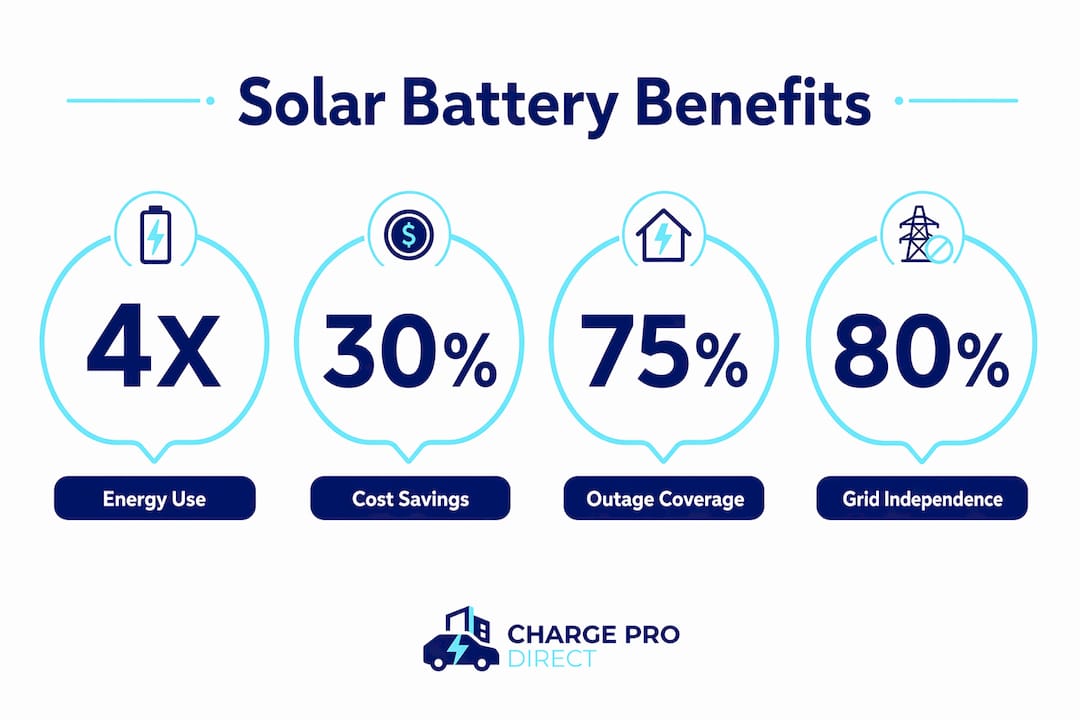
Battery storage delivers four concrete advantages that solar panels alone cannot provide.
Pairing batteries with solar lets you store energy that would otherwise be exported, increasing grid independence and outage capability. Higher self-consumption means you buy less electricity from your utility. That directly reduces your monthly bill, regardless of your local net metering policy.
The DOE confirms that storage enables operation during outages, a key benefit that solar alone cannot deliver. A standard grid-tied solar system shuts off automatically during a blackout for safety reasons. A battery system with the right inverter configuration keeps your critical loads running, whether that’s your refrigerator, medical equipment, or internet router.
Real-world scenario: During an extended winter outage, a properly sized battery system can keep critical loads like lights and a refrigerator running while the grid is down. That resilience is the clearest argument for storage.
Solar batteries allow homeowners to shift energy use to cheaper, low-rate periods and avoid drawing from the grid at peak rates. Utilities with time-of-use pricing charge two to three times more per kWh during evening peak hours than during midday. A battery charged by your solar panels during the day and discharged during the evening peak can produce meaningful monthly savings.
Storing solar energy on-site means more of your clean electricity actually powers your home. Without storage, excess solar exported to the grid may displace fossil fuel generation, but the benefit is indirect and depends on your grid’s energy mix. With storage, you maximize the clean energy your roof produces and minimize your draw from a grid that may still rely on gas peaker plants during high-demand hours.
For more on how storage reduces your grid dependence, the Chargeprodirect article on reducing grid dependence covers the mechanics clearly.
Getting the right system requires matching your battery to your actual needs, not just buying the biggest unit available.
List your critical loads. Identify which appliances must run during an outage: refrigerator, lights, phone chargers, HVAC, medical devices. Add up their wattage to determine the minimum power rating (kW) you need.
Estimate backup duration. Decide how many hours or days of backup you want. Multiply your critical load wattage by the number of hours to get the minimum capacity (kWh) required. A 3,000-watt critical load running for 8 hours needs at least 24 kWh of usable capacity.
Account for conversion losses. Homeowners must account for conversion losses in storage efficiency, expecting less usable energy than the raw kWh rating suggests. Plan for roughly 85–90% round-trip efficiency in your sizing calculations.
Check your solar surplus. A battery only fills from your panels if you generate more than you consume during the day. Review your solar production data by month to understand how much surplus is available for storage.
Evaluate your rate structure. Regions with strong time-of-use rates and weak net metering have the strongest financial case for solar batteries. If your utility offers full retail net metering, the financial payback period for a battery extends considerably.
Pro Tip: Use your utility bill’s hourly usage data, available through most online account portals, to map exactly when you consume the most power. That data makes battery sizing far more accurate than guessing.
| Factor | Lower battery value | Higher battery value |
|---|---|---|
| Net metering policy | Full retail credit | Avoided export or no credit |
| Rate structure | Flat rate | Time-of-use pricing |
| Outage frequency | Rare, short outages | Frequent or extended outages |
| Solar surplus | Minimal midday excess | Large midday surplus |
| Critical load needs | Low, flexible loads | High or medical-grade loads |
The whole home battery sizing guide at Chargeprodirect provides a step-by-step framework for working through these calculations.
Battery storage is not the right choice for every homeowner in every situation. Understanding the limits helps you make a confident, informed decision.
The honest answer is that battery storage delivers the most value when you have frequent outages, time-of-use rates, or limited net metering. If none of those apply to you, solar alone may meet your goals for now, with the option to add storage later as technology costs continue to fall.
Solar battery storage solves the timing mismatch between solar generation and household demand, making clean energy usable around the clock while building resilience against outages.
| Point | Details |
|---|---|
| Storage fixes the timing gap | Batteries charge during midday solar surplus and discharge during evening peak demand. |
| Backup power requires storage | Standard grid-tied solar shuts off during outages; only a battery system keeps critical loads running. |
| Size to your actual loads | Match kWh capacity and kW power rating to your critical appliances and desired backup duration. |
| Financial value depends on rates | Time-of-use pricing and weak net metering produce the strongest financial case for adding a battery. |
| Account for efficiency losses | Plan for 85–90% round-trip efficiency when calculating how much usable energy your battery will deliver. |
Many homeowners install solar panels expecting backup power, then learn otherwise during their first major outage. The panels shut off automatically, the house goes dark, and it becomes clear that solar alone is not the same as energy independence.
Utility rate structures are also changing. More states are moving toward time-of-use pricing as grids become more stressed. Homeowners who install batteries today are positioning themselves ahead of that shift. The financial case that looks marginal under today’s flat rates often looks much stronger in three years under a time-of-use structure.
The technology cost curve is also real. Lithium-ion battery prices have dropped dramatically over the past decade, and that trend continues. Waiting for prices to fall further is a reasonable strategy, but it means years of paying peak-rate electricity bills and having no backup during outages. For many homeowners, the resilience value alone can justify the investment, separate from any financial calculation.
Our recommendation: run your own numbers using your actual utility rate structure, your solar production data, and a realistic critical load list. The answer will be specific to your home, not a generic rule.
Chargeprodirect carries a curated selection of home battery backup systems sized for real homeowner needs, from single-room backup to whole-home energy independence. Every product page lists detailed specs, and our sizing guides help you select the right capacity and power rating the first time.

If you are also considering pairing your battery system with an EV charger to charge your vehicle from stored solar energy, the EVIQO Level 2 EV Charger 40A is a popular choice for homeowners building out a complete home energy system. Our Build Your System guide can help you match your battery, solar, and EV charging setup so everything works together from day one.
Solar battery storage is a system that captures excess electricity from your solar panels and stores it for use when the sun isn’t producing power. Most home systems use lithium-ion batteries and are measured in kilowatt-hours (kWh) of capacity.
Standard grid-tied solar panels shut off automatically during a grid outage for safety reasons. A battery system with the correct inverter configuration is required to keep your home powered during a blackout.
Backup duration depends on your battery’s kWh capacity, your power rating (kW), and which appliances you run. A 10 kWh battery powering a 1,000-watt critical load lasts approximately 10 hours, less when accounting for conversion losses.
The financial case is strongest in areas with time-of-use electricity rates or weak net metering policies. In states with full retail net metering and flat rates, the payback period is longer, and storage is better justified as a resilience investment.
List your critical appliances, add their wattage, and multiply by the hours of backup you want. Then add 10–15% to account for round-trip efficiency losses. The whole home battery sizing guide at Chargeprodirect walks through this calculation in detail.