
Need Installation?
Book a licensed install
Book a licensed EV charger install

A solar battery backup is a system that stores energy from your solar panels and delivers it to your home when the grid goes down or when electricity rates peak. Think of it as a rechargeable reserve that sits between your solar panels and your home’s electrical panel, ready to take over the moment the utility grid fails. These systems have matured significantly, with lifespans of 10–15 years and minimal maintenance requirements. As more homeowners add EVs to their garages, integrating a home battery backup with EV charging has become one of the smartest ways to maximize every kilowatt-hour your panels produce.
A solar battery backup system has four main components: solar panels, a battery bank, an inverter, and a charge controller. Each part plays a specific role in capturing, storing, and delivering power to your home.
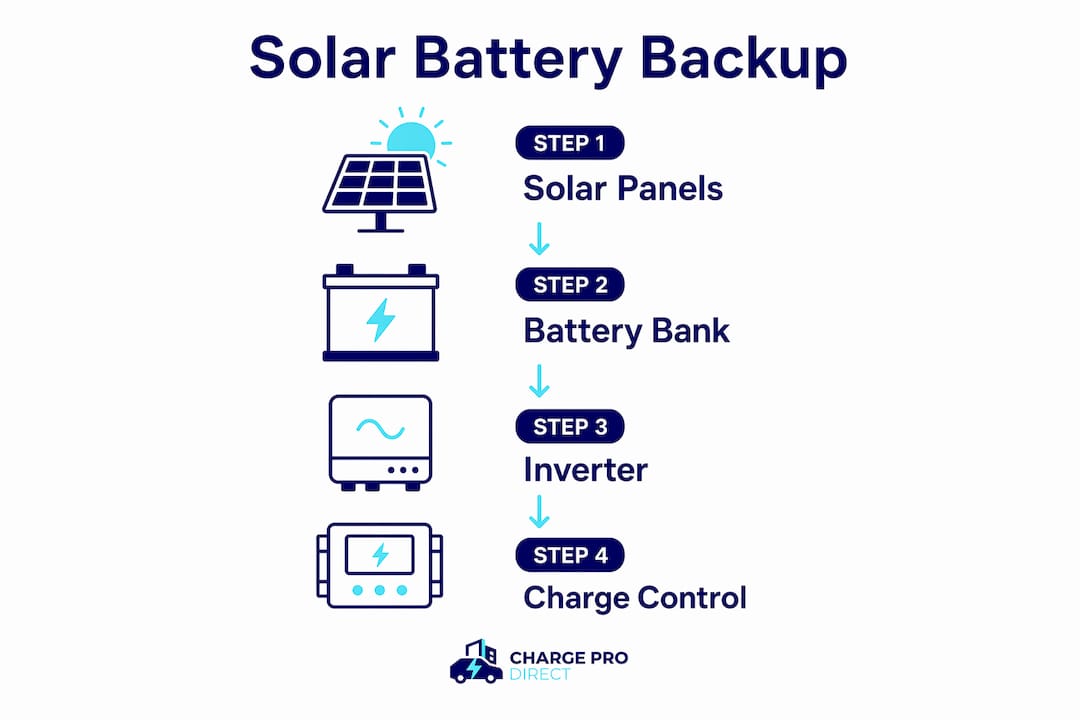
Solar panels generate DC electricity. That electricity either charges the battery directly or passes through an inverter to become AC power your home can use. The battery stores whatever energy you don’t use immediately. When the grid goes down, the system switches to battery power automatically, usually within milliseconds.
Understanding the difference between AC and DC coupling is worth your time. DC-coupled systems connect the battery directly to the solar panels before any conversion happens. This avoids extra conversion steps and delivers better efficiency, making DC coupling the preferred choice for new installations. AC-coupled systems, on the other hand, connect the battery after the inverter. They work well for retrofits because they pair with most existing solar inverters without requiring a full system replacement.
Pro Tip: Ask your installer whether your current inverter is “storage ready.” Many inverters sold after 2020 support battery integration with a firmware update rather than a full hardware swap.
Most modern systems use lithium iron phosphate (LFP) batteries. LFP chemistry offers a strong safety profile, a long cycle life, and stable performance across temperature ranges. The battery communicates with a hybrid inverter that manages charging from solar panels, discharging to your home, and grid interaction all at once.
For homeowners who also charge an EV, the energy management system inside a hybrid inverter can schedule EV charging during off-peak hours or when the battery is full, so you get the most out of your solar energy storage without wasting a single watt.
The most immediate benefit is outage protection. A well-sized battery keeps your lights, refrigerator, medical equipment, and internet running without any action on your part. Solar-plus-battery systems achieve over 80% uptime for 90% of the global population, and that figure climbs to 95–99% in sun-rich regions. That level of reliability is difficult to match with a conventional generator.
Here are the top benefits of a battery backup system:
The environmental case is equally strong. A battery backup system produces no carbon emissions during operation. Paired with solar panels, your home can run on clean energy for the majority of the year. When you add an EV charger to the mix, you can fuel your car entirely from sunlight, which is a meaningful reduction in your household’s carbon footprint.
Sizing is the most common place homeowners make costly mistakes. The right system size depends on three factors: how many essential circuits you want to back up, how long you need power during an outage, and the peak power demands of your appliances.
Whole-home solar plus battery systems typically cost between $25,000 and $50,000 in 2026, covering 8–24 hours of essential load. That range is wide because system size, battery chemistry, and local electrical infrastructure all affect the final price. A partial-home backup covering only critical loads costs considerably less.
Startup currents for appliances like well pumps and HVAC units can spike two to three times their rated wattage for a fraction of a second. A battery system sized only for continuous load will trip during those inrush events. Always size your system to handle peak power, not just average consumption.
Pro Tip: Pull your last 12 months of utility bills and identify your three highest-usage months. Size your battery to cover at least 24 hours of that peak daily usage for critical circuits.
Systems must meet UL 9540A for thermal runaway prevention to pass permitting in most jurisdictions. Skipping this step can result in permit denial and, more seriously, a fire risk. Always confirm your installer pulls the proper permits and that the equipment carries the required certifications.
| Consideration | What to evaluate |
|---|---|
| Battery capacity | kWh needed for 8–24 hours of critical load |
| Peak power rating | Must handle startup surge of HVAC and pumps |
| Coupling type | DC-coupled for new installs; AC-coupled for retrofits |
| Safety certification | UL 9540A compliance for permitting approval |
| EV charger integration | Inverter must support managed EV charging scheduling |
Working through this evaluation before purchase helps you select a system matched to your actual power needs rather than a generic size. Check the whole-home battery sizing guide for a detailed breakdown of how to calculate your requirements.
Yes, you can add battery backup to most existing solar systems, but the process requires an honest assessment of your current inverter. Not every older inverter supports battery integration. Here is what the retrofit process typically involves:
AC-coupled systems simplify retrofits because they work alongside your existing inverter rather than replacing it. The trade-off is a small efficiency loss from the extra AC-to-DC-to-AC conversion. For most homeowners, that efficiency gap is acceptable given the lower retrofit cost. If your inverter is more than eight years old, a full system replacement with a DC-coupled hybrid inverter often delivers better long-term value.
Understanding solar energy storage cycles helps you set realistic expectations for how a retrofitted battery will perform across seasons and usage patterns.
A solar battery backup system delivers reliable home power, lower electricity bills, and clean energy independence when sized correctly and paired with the right inverter.
| Point | Details |
|---|---|
| System lifespan | Solar batteries last 10–15 years with minimal maintenance, far outlasting most generators. |
| Cost range | Whole-home systems run $25,000–$50,000; partial-home critical-load systems cost less. |
| Size for peak power | Account for appliance startup surges, not just continuous wattage, to avoid outage failures. |
| Retrofit is possible | AC-coupled batteries work with most post-2020 inverters without a full system replacement. |
| VPP programs pay you | Battery owners in qualifying states earn utility credits by participating in Virtual Power Plants. |
A common pattern is how rarely homeowners plan for EV charging when they size their battery system. They design the battery around the refrigerator and the lights, then add an EV charger six months later and wonder why their battery drains faster than expected.
An EV charger pulling 9.6kW or 11.5kW overnight is the single largest load in most homes. If your battery system was not sized with that load in mind, you are either draining your reserve faster than solar can replenish it, or you are defaulting to grid power for charging anyway. That defeats a significant part of the financial and environmental case for the whole system.
The homeowners who get the most out of their solar investment are the ones who treat the battery, the solar array, and the EV charger as one integrated system from the start. They use their inverter’s energy management to charge the car during peak solar production hours, keep the battery topped up for evening use, and participate in VPP programs to earn credits on top of that. The solar generator vs. whole home battery comparison is worth reading if you are still deciding between backup approaches, because the right choice depends heavily on whether EV charging is part of your plan.
Our recommendation: get a professional load assessment before you buy anything. The math is not complicated, but the details matter. A system that is too small will frustrate you. A system that is too large will take years longer to pay back. Get the sizing right the first time.
Chargeprodirect carries a full selection of home battery backup systems, hybrid inverters, complete solar kits, and Level 2 EV chargers, all in one place. Our sizing guides help homeowners match the right battery capacity to their actual load, including EV charging, so you avoid the common sizing mistakes that cost money down the road.

Whether you are starting fresh with a complete solar kit or adding a Level 2 EV charger to an existing system, residential EV chargers ship free, and flexible payment plans are available at checkout. Browse the EVIQO 48A Level 2 EV Charger for a hardwired home charging option that pairs well with a solar battery setup, or use the EV charger finder to identify the right model for your vehicle and panel capacity.
Most residential systems provide 8–24 hours of essential load coverage on a full charge. Runtime extends significantly when solar panels continue generating power during daylight hours.
DC-coupled systems are more efficient for new installations because they avoid extra energy conversion steps. AC-coupled systems are simpler for retrofits because they work alongside most existing solar inverters.
Yes. Most jurisdictions require permits for battery installations, and systems must meet safety standards such as UL 9540A for thermal runaway prevention to receive approval.
A Level 2 EV charger draws significant power, typically 7.2–11.5kW. Your battery system must be sized to handle that load alongside other critical circuits, or you will need to manage charging manually during an outage.
A Virtual Power Plant is a network of home batteries that utilities can draw on during peak demand. Participating homeowners receive utility credits or payments, turning their battery from a cost into a partial revenue source.