
Need Installation?
Book a licensed install
Book a licensed EV charger install

A solar charge controller is defined as a voltage and current regulator that sits between your solar panels and your battery bank, controlling how much electricity flows into storage. Without one, solar panels push unregulated power directly into batteries, causing overcharging, overheating, and permanent damage. The controller also acts as a one-way valve, blocking reverse current from draining your batteries back through the panels at night. Understanding what does a solar charge controller do is the first step toward building a solar power management system that actually protects your investment and keeps your batteries healthy for years.
A solar charge controller manages battery charging through a three-stage charging cycle called Bulk, Absorption, and Float. Each stage serves a specific purpose, and skipping any one of them shortens battery life significantly.
Here is how each stage works:
This sequence matters because batteries are not simple containers. Push too much current in too fast, and the internal chemistry breaks down. The multi-stage charging cycle prevents the gassing and plate damage that cut battery capacity permanently.
The controller also reads battery voltage continuously to decide which stage to apply. When voltage is low, it pushes hard. When voltage climbs, it backs off. That real-time adjustment is what separates a controller from a simple wire connection.

At night, solar panels produce no power but can actually pull a small current from a fully charged battery. A charge controller prevents reverse current flow by acting as an electronic check valve, blocking that drain automatically.
Pro Tip: If your system sits unused for several days, the Float stage keeps your battery ready without damage. Never disconnect the controller to “save” the battery during downtime.
Two technologies dominate the market: PWM (Pulse Width Modulation) and MPPT (Maximum Power Point Tracking). They solve the same problem differently, and the gap in performance is significant.
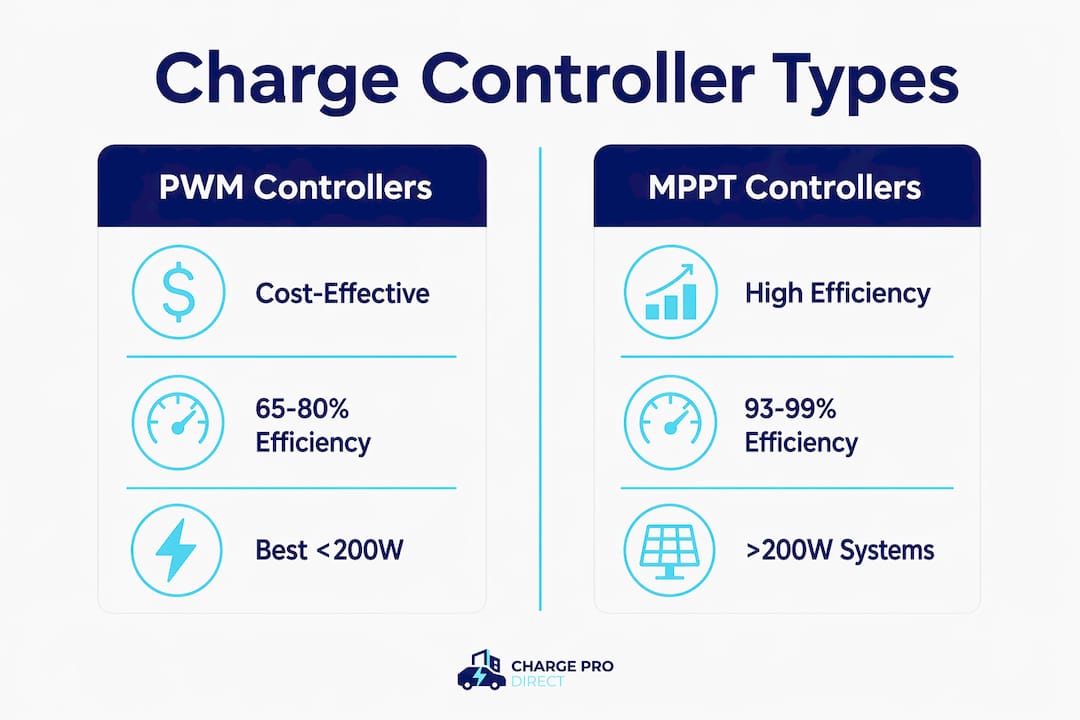
PWM controllers work by rapidly switching the connection between the panel and battery on and off. This pulse action tapers current as the battery fills. PWM units are simple, affordable, and reliable for small setups. They work best when your panel voltage closely matches your battery voltage.
MPPT controllers are more sophisticated. They continuously scan the panel’s output to find the exact voltage and current combination that produces maximum power, then convert that power to match what the battery needs. MPPT controllers reach 93–99% efficiency, compared to 65–80% for PWM models. That difference means more usable energy stored each day.
| Feature | PWM controllers | MPPT controllers |
|---|---|---|
| Efficiency | 65–80% | 93–99% |
| Best system size | Under 200W | 200W and above |
| Panel-to-battery voltage match | Required | Not required |
| Cost | Lower upfront | Higher upfront |
| Weather adaptability | Limited | Excellent |
PWM suits small systems like a single panel charging a 12V battery for a shed or RV. MPPT is the standard for home solar setups, especially where panels are wired in series at higher voltages or where weather varies frequently.
A common misconception is that a bigger controller always means better performance. The controller must match your specific panel array and battery bank. Oversizing wastes money; undersizing causes failure.
Battery protection is the core reason every solar system needs a charge controller. Incorrect charging voltages or mismatched chemistry profiles cause permanent plate damage and capacity loss. That damage often accumulates invisibly, showing up as a sudden system failure months after installation.
The controller protects batteries in several specific ways:
Understanding your battery storage cycle helps you configure these settings correctly from day one.
Pro Tip: Always verify your controller’s battery chemistry setting before connecting your battery bank. A controller programmed for lead-acid will overcharge a lithium battery on the very first sunny day.
Common user errors include pairing a 12V controller with a 24V battery bank, using a PWM controller with a high-voltage panel array, and ignoring LVD settings entirely. Each mistake accelerates battery wear in ways that are not immediately visible.
Sizing a solar charge controller correctly protects both your batteries and the controller itself. The process is straightforward when you follow the right steps.
A good solar panel and battery pairing guide walks you through matching these specs before you buy anything. Getting the pairing right before purchase prevents the most common pre-installation errors.
For most homeowners with a system larger than 200W, an MPPT controller is the better long-term choice. The upfront cost is higher, but the efficiency gains and battery protection features pay back that difference over time.
A solar charge controller is the single most important protective device in any battery-based solar system, managing voltage, current, and discharge to extend battery life and maximize energy storage.
| Point | Details |
|---|---|
| Three-stage charging cycle | Bulk, Absorption, and Float stages prevent overcharging and battery damage. |
| MPPT vs. PWM efficiency | MPPT controllers reach 93–99% efficiency; PWM tops out at 65–80%. |
| Battery chemistry matching | Using the wrong charging profile for LiFePO4 or lead-acid batteries causes irreversible damage. |
| Low Voltage Disconnect | LVD prevents deep discharge, preserving battery capacity over hundreds of cycles. |
| Correct sizing matters | Size by maximum short-circuit current, not just battery capacity, to avoid controller failure. |
Many homeowners treat a solar charge controller like a simple on/off switch, something you buy cheap and forget about. That mindset is the single most expensive mistake in residential solar.
The controller is the brain of your solar power management system. It reads your battery’s state of charge in real time, adjusts current and voltage dynamically, and protects a battery bank that often costs more than the panels themselves. Skimping on the controller to save $50 upfront can cost you $500 in premature battery replacement within two years.
Another common mistake is ignoring battery chemistry settings at setup. Most people plug everything in and assume the default settings are correct. They are not. A controller shipped from the factory defaults to flooded lead-acid in most cases. If you connect a LiFePO4 battery without changing that setting, you are overcharging it from day one, and the damage is invisible until the battery suddenly fails.
Our advice: invest in an MPPT controller for any home system over 200W, verify your battery chemistry profile before the first charge, and treat the LVD setting as non-negotiable. The importance of a solar charge controller goes well beyond basic regulation. It is the difference between a solar system that lasts 10 years and one that needs a battery replacement in 18 months.
If you are ready to put a properly sized solar system together, Chargeprodirect makes that process straightforward. Our catalog helps homeowners choose the right equipment for their specific power needs, from complete solar kits that bundle panels, batteries, and inverters, to solar generators for off-grid power that include integrated charge management.

Our Build Your System guide helps with battery sizing before you buy, and our product pages list controller specs you can check, so you avoid the mismatched setups that cause premature battery failure. Flexible payment plans make it easier to get the right system without cutting corners on the components that matter most. Browse the full solar lineup at Chargeprodirect and find the components that fit your home’s power needs.
A solar charge controller regulates voltage and current from solar panels to batteries, preventing overcharging, overheating, and reverse current flow at night. It manages a three-stage charging cycle to protect battery health and maximize stored energy.
Any solar system connected to a battery bank needs a charge controller. Without one, unregulated panel output will overcharge and permanently damage your batteries within a short time.
PWM controllers are cost-effective for small systems under 200W but operate at 65–80% efficiency. MPPT controllers reach 93–99% efficiency and are the standard choice for larger home solar systems or setups with higher panel voltages.
Low Voltage Disconnect (LVD) automatically cuts power to connected loads when battery voltage drops below a set threshold, preventing the deep discharge that causes permanent capacity loss in both lead-acid and lithium batteries.
Many modern controllers support multiple battery chemistry profiles, but you must manually select the correct profile for your battery type. Using a lead-acid profile on a LiFePO4 battery causes overcharging and can void your battery warranty.